Plot elements such as adventure, travel to far-flung regions, the criminal underworld, and embezzlement schemes are not usually associated with Soviet literature, yet an entire body of work produced between the October Revolution and the Stalinist Great Terror was constructed around them.
In Writing RoguesCassio de Oliveira sheds light on the picaresque and its marginal characters – rogues and storytellers – who populated the Soviet Union on paper and in real life. The picaresque afforded authors the means to articulate and reflect on the Soviet collective identity, a class-based utopia that rejected imperial power and attempted to deemphasize national allegiances. Combining new readings of canonical works with in-depth analysis of neglected texts, Writing Rogues explores the proliferation of characters left on the sidelines of the communist transition, including gangsters, con men, and petty thieves, many of them portrayed as ethnic minorities. The book engages with scholarship on Soviet subjectivity as well as classical picaresque literature in order to explain how the subversive rogue – such as Ilf and Petrov's wildly popular cynic and schemer Ostap Bender – in the process of becoming a fully fledged Soviet citizen, came to expose and embody the contradictions of Soviet life itself.
Writing Rogues enriches our understanding of how literature was called upon to participate in the construction of Soviet identity. It demonstrates that the Soviet picaresque resonated with individual citizens' fears and aspirations as it recorded the country's transformation into the first communist state.
eBook - ePub
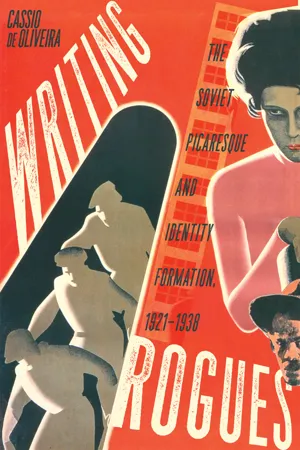
Writing Rogues
The Soviet Picaresque and Identity Formation, 1921–1938
- 312 pages
- English
- ePUB (mobile friendly)
- Available on iOS & Android
eBook - ePub
Writing Rogues
The Soviet Picaresque and Identity Formation, 1921–1938
About this book
Information
Table of contents
- Cover
- Copyright
- Contents
- Figures
- Acknowledgments
- Introduction
- PART ONE Wartime Autobiographies
- 1 Ehrenburg’s and Shklovsky’s Autobiographies as Self-effacement
- 2 Travels and Travails in Julio Jurenito and A Sentimental Journey
- PART TWO The NEP-Era Rogue and the Idea of Soviet Literature
- 3 From Odessa to Petrograd
- 4 Grabber, Kynik, and Thief
- PART THREE The Soviet Picaresqueand the Stalinist Rogue
- 5 Travelling and BuildingStalin’s Soviet Union
- 6 “In Every Life There Is at Least One Interesting Plot”
- CONCLUSION
- Notes
- Bibliography
- Index
Trusted by 375,005 students
Access to over 1.5 million titles for a fair monthly price.
Study more efficiently using our study tools.
Frequently asked questions
Yes, you can cancel anytime from the Subscription tab in your account settings on the Perlego website. Your subscription will stay active until the end of your current billing period. Learn how to cancel your subscription
No, books cannot be downloaded as external files, such as PDFs, for use outside of Perlego. However, you can download books within the Perlego app for offline reading on mobile or tablet. Learn how to download books offline
Perlego offers two plans: Essential and Complete
- Essential is ideal for learners and professionals who enjoy exploring a wide range of subjects. Access the Essential Library with 800,000+ trusted titles and best-sellers across business, personal growth, and the humanities. Includes unlimited reading time and Standard Read Aloud voice.
- Complete: Perfect for advanced learners and researchers needing full, unrestricted access. Unlock 1.5M+ books across hundreds of subjects, including academic and specialized titles. The Complete Plan also includes advanced features like Premium Read Aloud and Research Assistant.
We are an online textbook subscription service, where you can get access to an entire online library for less than the price of a single book per month. With over 1.5 million books across 990+ topics, we’ve got you covered! Learn about our mission
Look out for the read-aloud symbol on your next book to see if you can listen to it. The read-aloud tool reads text aloud for you, highlighting the text as it is being read. You can pause it, speed it up and slow it down. Learn more about Read Aloud
Yes! You can use the Perlego app on both iOS and Android devices to read anytime, anywhere — even offline. Perfect for commutes or when you’re on the go.
Please note we cannot support devices running on iOS 13 and Android 7 or earlier. Learn more about using the app
Please note we cannot support devices running on iOS 13 and Android 7 or earlier. Learn more about using the app
Yes, you can access Writing Rogues by Cassio de Oliveira,Cassio De Oliveira in PDF and/or ePUB format, as well as other popular books in Literature & Modern Literary Criticism. We have over 1.5 million books available in our catalogue for you to explore.