- English
- ePUB (mobile friendly)
- Available on iOS & Android
eBook - ePub
About this book
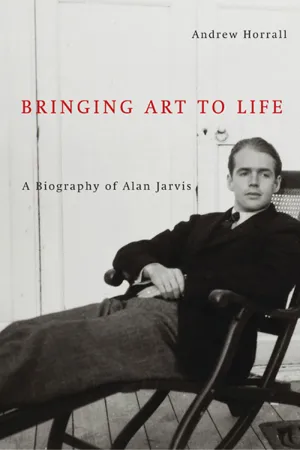
Only thirty-nine when he took over the National Gallery in 1955, Jarvis already had an extraordinary record of achievement and social mobility at home and in England: he had trained with Canada's greatest artists, won a Rhodes scholarship, lunched at the Algonquin Round Table in New York, managed an aircraft factory, written a bestseller, produced films, run a slum settlement, and moved in a London social circle that included Noël Coward and Vivien Leigh. As head of the National Gallery, Jarvis was a provocative public educator, advocating his idea of "a museum without walls" in countless public appearances. Instrumental in bringing modern art to the National Gallery, he shook artists and the art-minded public out of a period of national complacency. This first detailed account of the controversy surrounding his time at the gallery provides an important context for the ongoing and contested role of publicly supported arts and art institutions in this country.
Information
Print ISBN
9780773535749
Table of contents
- Cover Page
- Title Page
- Copyright Page
- Dedication
- Contents
- List of Illustrations
- Acknowledgments
- Selection of Work Acquired during Jarvis’ Time as Director
- One: A Walking Work of Art”: Introduction
- Two: “A Curiously Mixed Background”: Family and Childhood, 1915–1934
- Three: “Douglas Duncan Invented Me”: Undergraduate, 1934–1938
- Four: “I May Come Home with an Accent – God Forbid”: Europe, Oxford, and Dartington, 1938–1939
- Five: “The Dead Days”: Toronto and New York City, 1939–1941
- Six: “Up to My Ears in the Business World”: England, 1942–1945
- Seven: “To Build a New Kind of Society”: The Council of Industrial Design, 1945–1947
- Eight: “A Break in a Million”: Pilgrim Pictures, 1948–1950
- Nine: “I Certainly Hope 1950 Will Be Different”: Oxford House, 1950–1955
- Ten: “A Museum without Walls”: The National Gallery of Canada, 1955–1956
- Eleven: “A Chamber of Horrors”: The National Gallery of Canada, 1957–1959
- Twelve: “Canada’s Most Outspoken and Witty Man About the Arts”: Toronto, 1960–1968
- Thirteen: “We Have Lost Our Sheep Dog”: The Last Years, 1968–1972
- Conclusion
- Notes
- Bibliography
- Index
Trusted by 375,005 students
Access to over 1.5 million titles for a fair monthly price.
Study more efficiently using our study tools.