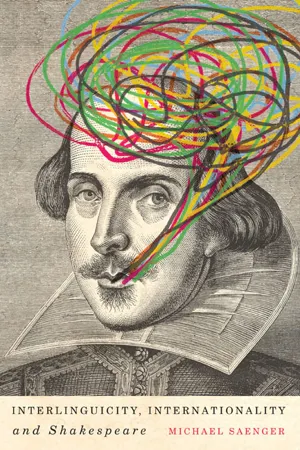
Languages have become more mobile than ever before, producing translations, transplantations, and cohabitations of all kinds. The early modern period also witnessed profound linguistic transformation, but in very different ways. Interlinguicity, Internationality, and Shakespeare undoes the illusion that Shakespeare wrote in what we now think of as English.
In a series of essays approaching Shakespeare from unique and thought-provoking perspectives, contributors from history, performance criticism, and comparative literature look at "interlinguicity," the condition of being between languages, and "internationality," the condition of being between countries. Each essay focuses on local issues, such as community identification in the Netherlands of Shakespeare’s time and the appropriation of Shakespeare in German literature in the nineteenth century, to suggest that Shakespeare never wrote "in" English because English was not then, nor is it now, an intact, knowable system.
Many languages existed in sixteenth-century London, and English did not have clear limits. Interlinguicity, Internationality, and Shakespeare helps to explain the hybridity that Shakespeare embraced in all his writing.
Contributors include Paula Blank (College of William and Mary), Lauren Coker (Saint Louis University), Brian Gingrich (Princeton University), Alexa Huang (George Washington University), James Loehlin (University of Texas at Austin), Scott Newstok (Rhodes College), Patricia Parker (Stanford University), Elizabeth Pentland (York University), Philip Schwyzer (University of Exeter), Gary Waite (University of New Brunswick), and Robert N. Watson (University of California, Los Angeles)
- English
- ePUB (mobile friendly)
- Available on iOS & Android
eBook - ePub
Interlinguicity, Internationality, and Shakespeare
About this book
Information
Publisher
McGill-Queen's University PressYear
2015Print ISBN
9780773544741
9780773544734
eBook ISBN
9780773596900
Table of contents
- Cover
- Contents
- Title
- Copyright
- Acknowledgments
- Contributors
- Introduction
- PART ONE - The Meaning of Foreign Languages
- PART TWO - Difference within English
- PART THREE - Shakespeare and Cultural Voice
- Afterword
- Index
Trusted by 375,005 students
Access to over 1.5 million titles for a fair monthly price.
Study more efficiently using our study tools.
Frequently asked questions
Yes, you can cancel anytime from the Subscription tab in your account settings on the Perlego website. Your subscription will stay active until the end of your current billing period. Learn how to cancel your subscription
No, books cannot be downloaded as external files, such as PDFs, for use outside of Perlego. However, you can download books within the Perlego app for offline reading on mobile or tablet. Learn how to download books offline
Perlego offers two plans: Essential and Complete
- Essential is ideal for learners and professionals who enjoy exploring a wide range of subjects. Access the Essential Library with 800,000+ trusted titles and best-sellers across business, personal growth, and the humanities. Includes unlimited reading time and Standard Read Aloud voice.
- Complete: Perfect for advanced learners and researchers needing full, unrestricted access. Unlock 1.5M+ books across hundreds of subjects, including academic and specialized titles. The Complete Plan also includes advanced features like Premium Read Aloud and Research Assistant.
We are an online textbook subscription service, where you can get access to an entire online library for less than the price of a single book per month. With over 1.5 million books across 990+ topics, we’ve got you covered! Learn about our mission
Look out for the read-aloud symbol on your next book to see if you can listen to it. The read-aloud tool reads text aloud for you, highlighting the text as it is being read. You can pause it, speed it up and slow it down. Learn more about Read Aloud
Yes! You can use the Perlego app on both iOS and Android devices to read anytime, anywhere — even offline. Perfect for commutes or when you’re on the go.
Please note we cannot support devices running on iOS 13 and Android 7 or earlier. Learn more about using the app
Please note we cannot support devices running on iOS 13 and Android 7 or earlier. Learn more about using the app
Yes, you can access Interlinguicity, Internationality, and Shakespeare by Michael Saenger in PDF and/or ePUB format, as well as other popular books in Literature & Literary Criticism of Shakespeare. We have over 1.5 million books available in our catalogue for you to explore.