Between 1867 and 2000, the Canadian government sent over 150,000 Aboriginal children to residential schools across the country. Government officials and missionaries agreed that in order to “civilize and Christianize” Aboriginal children, it was necessary to separate them from their parents and their home communities.
For children, life in these schools was lonely and alien. Discipline was harsh, and daily life was highly regimented. Aboriginal languages and cultures were denigrated and suppressed. Education and technical training too often gave way to the drudgery of doing the chores necessary to make the schools self-sustaining. Child neglect was institutionalized, and the lack of supervision created situations where students were prey to sexual and physical abusers.
Legal action by the schools’ former students led to the creation of the Truth and Reconciliation Commission of Canada in 2008. The product of over six years of research, the Commission’s final report outlines the history and legacy of the schools, and charts a pathway towards reconciliation.
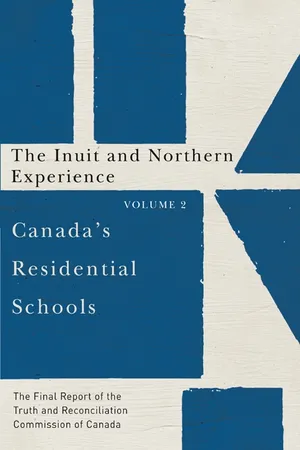
Canada’s Residential Schools: The Inuit and Northern Experience demonstrates that residential schooling followed a unique trajectory in the North. As late as 1950 there were only six residential schools and one hostel north of the sixtieth parallel. Prior to the 1950s, the federal government left northern residential schools in the hands of the missionary societies that operated largely in the Mackenzie Valley and the Yukon. It was only in the 1950s that Inuit children began attending residential schools in large numbers. The tremendous distances that Inuit children had to travel to school meant that, in some cases, they were separated from their parents for years. The establishment of day schools and what were termed small hostels in over a dozen communities in the eastern Arctic led many Inuit parents to settle in those communities on a year-round basis so as not to be separated from their children, contributing to a dramatic transformation of the Inuit economy and way of life.
Not all the northern institutions are remembered similarly. The staff at Grandin College in Fort Smith and the Churchill Vocational Centre in northern Manitoba were often cited for the positive roles that they played in developing and encouraging a new generation of Aboriginal leadership. The legacy of other schools, particularly Grollier Hall in Inuvik and Turquetil Hall in Igluligaarjuk (Chesterfield Inlet), is far darker. These schools were marked by prolonged regimes of sexual abuse and harsh discipline that scarred more than one generation of children for life.
Since Aboriginal people make up a large proportion of the population in Canada’s northern territories, the impact of the schools has been felt intensely through the region. And because the history of these schools is so recent, the intergenerational impacts and the legacy of the schools are strongly felt in the North.
- English
- ePUB (mobile friendly)
- Available on iOS & Android
eBook - ePub
About this book
Information
Publisher
McGill-Queen's University PressYear
2015Print ISBN
9780773546547
9780773546530
eBook ISBN
9780773598225
Table of contents
- Canada’s Residential Schools: The Inuit and Northern Experience: Volume 2
- Title
- Copyright
- Contents
- Introduction
- Section 1: Mission schools in the North: 1867 to 1960
- 1. An era of neglect: Canadian government policy in the North before 1950
- 2. Laying the groundwork: Mission schools: 1850 to 1900
- 3. Mission schools of the Northwest Territories: 1900 to 1960
- 4. Student Life at the Mission Schools
- 5. Education for what purpose?
- 6. The mission era in the Yukon
- Section 2: Bureaucrats replace missionaries: Residential schooling in the North after 1950
- Introduction
- 7. The federal government rethinks its northern policy
- 8. The federal day schools
- 9. The large hostels
- 10. The small hostels
- 11. Territorial administration: 1969 to 1997
- 12. The residential school experience in Arctic Québec and Labrador
- Conclusion
- Notes
- Bibliography
- Index
Trusted by 375,005 students
Access to over 1.5 million titles for a fair monthly price.
Study more efficiently using our study tools.
Frequently asked questions
Yes, you can cancel anytime from the Subscription tab in your account settings on the Perlego website. Your subscription will stay active until the end of your current billing period. Learn how to cancel your subscription
No, books cannot be downloaded as external files, such as PDFs, for use outside of Perlego. However, you can download books within the Perlego app for offline reading on mobile or tablet. Learn how to download books offline
Perlego offers two plans: Essential and Complete
- Essential is ideal for learners and professionals who enjoy exploring a wide range of subjects. Access the Essential Library with 800,000+ trusted titles and best-sellers across business, personal growth, and the humanities. Includes unlimited reading time and Standard Read Aloud voice.
- Complete: Perfect for advanced learners and researchers needing full, unrestricted access. Unlock 1.5M+ books across hundreds of subjects, including academic and specialized titles. The Complete Plan also includes advanced features like Premium Read Aloud and Research Assistant.
We are an online textbook subscription service, where you can get access to an entire online library for less than the price of a single book per month. With over 1.5 million books across 990+ topics, we’ve got you covered! Learn about our mission
Look out for the read-aloud symbol on your next book to see if you can listen to it. The read-aloud tool reads text aloud for you, highlighting the text as it is being read. You can pause it, speed it up and slow it down. Learn more about Read Aloud
Yes! You can use the Perlego app on both iOS and Android devices to read anytime, anywhere — even offline. Perfect for commutes or when you’re on the go.
Please note we cannot support devices running on iOS 13 and Android 7 or earlier. Learn more about using the app
Please note we cannot support devices running on iOS 13 and Android 7 or earlier. Learn more about using the app
Yes, you can access Canada’s Residential Schools: The Inuit and Northern Experience by in PDF and/or ePUB format, as well as other popular books in Social Sciences & North American History. We have over 1.5 million books available in our catalogue for you to explore.