In Adapted Brains and Imaginary Worlds, Donald Beecher explores the characteristics and idiosyncrasies of the brain as they affect the study of fiction. He builds upon insights from the cognitive sciences to explain how we actualize imaginary persons, read the clues to their intentional states, assess their representations of selfhood, and empathize with their felt experiences in imaginary environments. He considers how our own faculty of memory, in all its selective particularity and planned oblivion, becomes an increasingly significant dimension of the critical act, and how our own emotions become aggressive readers of literary experience, culminating in states which define the genres of literature.
Beecher illustrates his points with examples from major works of the Renaissance period, including Dr Faustus, The Faerie Queene, Measure for Measure, The Yorkshire Tragedy, Menaphon, The Dialogue of Solomon and Marcolphus, and The Moral Philosophy of Doni. In this volume, studies in the science of mind come into their own in explaining the architectures of the brain that shape such emergent properties as empathy, suspense, curiosity, the formation of communities, gossip, rationalization, confabulation, and so much more that pertains to the behaviour of characters, the orientation of readers, and the construction of meaning.
Discussing a breadth of topics - from the mysteries of the criminal mind to the psychology of tears - Adapted Brains and Imaginary Worlds is the most comprehensive work available on the study of fictional worlds and their relation to the constitution of the human brain.
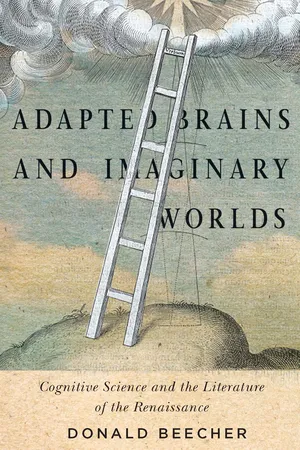
eBook - ePub
Adapted Brains and Imaginary Worlds
Cognitive Science and the Literature of the Renaissance
- English
- ePUB (mobile friendly)
- Available on iOS & Android
eBook - ePub
Adapted Brains and Imaginary Worlds
Cognitive Science and the Literature of the Renaissance
About this book
Information
Publisher
McGill-Queen's University PressYear
2016Print ISBN
9780773546813
9780773546806
eBook ISBN
9780773598539
Table of contents
- Cover
- Title
- Copyright
- Contents
- Acknowledgments
- Introduction
- 1 On the Obsessions of Selfhood: Doctor Faustus and the Dramatization of Consciousness
- 2 The Biogenesis of Ethics and the Challenge of Shakespeare’s Measure for Measure
- 3 On the Emotional Intentionality of Criminal Protagonists: The Yorkshire Tragedy
- 4 On the Systemic Properties of Recollection: Emboxed Narratives and the Limits of Memory in Edmund Spenser’s The Faerie Queene and Thomas North’s The Moral Philosophy of Doni
- 5 Crying and the Ambiguity of Shakespeare’s All’s Well That Ends Well
- 6 Toward a Cognitive Theory of Proverbs: The Dialogue of Solomon and Marcolphus
- 7 Romance and the Universality of Human Nature: Heliodorus, Aethiopica and Robert Greene, Menaphon
- 8 Suspense . . . .
- 9 Laughter’s Shortfall: The Aesthetics of Renaissance Tragicomedy, The Witch of Edmonton and The History of James the Fourth
- 10 Cognition, Conversion, and the Patterns of Religious Experience: Francesco Petrarch’s Familiar Letters, IV.1
- 11 Folk Psychology and Theory of Mind: John Marston’s The Fawn
- Notes
- Bibliography
- Index
Trusted by 375,005 students
Access to over 1.5 million titles for a fair monthly price.
Study more efficiently using our study tools.
Frequently asked questions
Yes, you can cancel anytime from the Subscription tab in your account settings on the Perlego website. Your subscription will stay active until the end of your current billing period. Learn how to cancel your subscription
No, books cannot be downloaded as external files, such as PDFs, for use outside of Perlego. However, you can download books within the Perlego app for offline reading on mobile or tablet. Learn how to download books offline
Perlego offers two plans: Essential and Complete
- Essential is ideal for learners and professionals who enjoy exploring a wide range of subjects. Access the Essential Library with 800,000+ trusted titles and best-sellers across business, personal growth, and the humanities. Includes unlimited reading time and Standard Read Aloud voice.
- Complete: Perfect for advanced learners and researchers needing full, unrestricted access. Unlock 1.5M+ books across hundreds of subjects, including academic and specialized titles. The Complete Plan also includes advanced features like Premium Read Aloud and Research Assistant.
We are an online textbook subscription service, where you can get access to an entire online library for less than the price of a single book per month. With over 1.5 million books across 990+ topics, we’ve got you covered! Learn about our mission
Look out for the read-aloud symbol on your next book to see if you can listen to it. The read-aloud tool reads text aloud for you, highlighting the text as it is being read. You can pause it, speed it up and slow it down. Learn more about Read Aloud
Yes! You can use the Perlego app on both iOS and Android devices to read anytime, anywhere — even offline. Perfect for commutes or when you’re on the go.
Please note we cannot support devices running on iOS 13 and Android 7 or earlier. Learn more about using the app
Please note we cannot support devices running on iOS 13 and Android 7 or earlier. Learn more about using the app
Yes, you can access Adapted Brains and Imaginary Worlds by Donald Beecher in PDF and/or ePUB format, as well as other popular books in Literature & Literary Criticism Theory. We have over 1.5 million books available in our catalogue for you to explore.