Charles Booth’s seventeen-volume series, The Life and Labour of the People in London (1886-1903), is a staple of late Victorian social history and a monumental work of scholarship. Despite these facts, historians have paid little attention to its section on religious influences. Thomas Gibson-Brydon’s The Moral Mapping of Victorian and Edwardian London seeks to remedy this neglect.
Combing through the interviews Booth and his researchers conducted with 1,800 churchmen and women, Gibson-Brydon not only brings to life a cast of characters - from “Jesusist” vicars to Peckham Rye preachers to women drinkers - but also uncovers a city-wide audit of charitable giving and philanthropic practices. Discussing the philosophy of Booth, the genesis of his Religious Influences Series, and the agents and recipients of London charity, this study is a frank testimony on British moral segregation at the turn of the century. In critiquing the idea of working-class solidarity and community-building traditionally portrayed by many leading social and labour historians, Gibson-Brydon displays a meaner, bleaker reality in London’s teeming neighbourhoods.
Demonstrating the wealth of untapped information that can be gleaned from Booth’s archives, The Moral Mapping of Victorian and Edwardian London raises new questions about working-class communities, cultures, urbanization, and religion at the height of the British Empire.
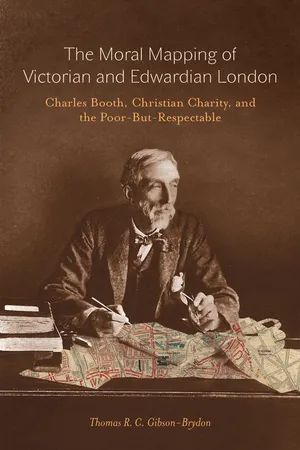
eBook - ePub
The Moral Mapping of Victorian and Edwardian London
Charles Booth, Christian Charity, and the Poor-but-Respectable
- English
- ePUB (mobile friendly)
- Available on iOS & Android
eBook - ePub
The Moral Mapping of Victorian and Edwardian London
Charles Booth, Christian Charity, and the Poor-but-Respectable
About this book
Information
Publisher
McGill-Queen's University PressYear
2016Print ISBN
9780773546875
9780773546868
eBook ISBN
9780773598614
Table of contents
- Cover
- Copyright
- Contents
- Preface
- Introduction
- 1 Charles Booth: The Making of a Victorian Social Scientist
- 2 The “Religious Influences” Series: What It Was and What Booth Proposed
- 3 “Ordinary Mortals”: History and Holy Men of London
- 4 Women and Charity: Love, Feminism, and “Men’s Worlds”
- 5 The Hard Lines of the Working-Class Hierarchy
- 6 Discipline and Release: Religion and Drink
- Conclusion
- Notes
- Bibliography
- Index
Trusted by 375,005 students
Access to over 1.5 million titles for a fair monthly price.
Study more efficiently using our study tools.
Frequently asked questions
Yes, you can cancel anytime from the Subscription tab in your account settings on the Perlego website. Your subscription will stay active until the end of your current billing period. Learn how to cancel your subscription
No, books cannot be downloaded as external files, such as PDFs, for use outside of Perlego. However, you can download books within the Perlego app for offline reading on mobile or tablet. Learn how to download books offline
Perlego offers two plans: Essential and Complete
- Essential is ideal for learners and professionals who enjoy exploring a wide range of subjects. Access the Essential Library with 800,000+ trusted titles and best-sellers across business, personal growth, and the humanities. Includes unlimited reading time and Standard Read Aloud voice.
- Complete: Perfect for advanced learners and researchers needing full, unrestricted access. Unlock 1.5M+ books across hundreds of subjects, including academic and specialized titles. The Complete Plan also includes advanced features like Premium Read Aloud and Research Assistant.
We are an online textbook subscription service, where you can get access to an entire online library for less than the price of a single book per month. With over 1.5 million books across 990+ topics, we’ve got you covered! Learn about our mission
Look out for the read-aloud symbol on your next book to see if you can listen to it. The read-aloud tool reads text aloud for you, highlighting the text as it is being read. You can pause it, speed it up and slow it down. Learn more about Read Aloud
Yes! You can use the Perlego app on both iOS and Android devices to read anytime, anywhere — even offline. Perfect for commutes or when you’re on the go.
Please note we cannot support devices running on iOS 13 and Android 7 or earlier. Learn more about using the app
Please note we cannot support devices running on iOS 13 and Android 7 or earlier. Learn more about using the app
Yes, you can access The Moral Mapping of Victorian and Edwardian London by Thomas R.C. Gibson-Brydon in PDF and/or ePUB format, as well as other popular books in History & British History. We have over 1.5 million books available in our catalogue for you to explore.