During the 2015 federal election, the Liberal Party pledged that, if elected, they would end the “first past the post” electoral system, where whichever candidate receives the most votes wins a riding even if they have not received a majority of all votes cast. In early 2017, the Liberals reneged on their campaign promise, declaring that there was a lack of public consensus about how to reform the system. Despite the broken promise - and because of the public outcry - discussions about electoral reform will continue around the country.
Challenging the idea that first past the post is obsolete, Should We Change How We Vote? urges Canadians to make sure they understand their electoral system before making drastic changes to it. The contributors to this volume assert that there is perhaps no institution more misunderstood and misrepresented than the Canadian electoral system - praised by some for ensuring broad regional representation in Ottawa, but criticized by others for allowing political parties with less than half the popular vote to assume more than half the seats in Parliament. They consider not only how the system works, but also its flaws and its advantages, and whether or not electoral reform is legitimate without a referendum.
An essential guide to the crucial and ongoing debate about the country’s future, Should We Change How We Vote? asks if there are alternative reforms that would be easier to implement than a complete overhaul of the electoral system.
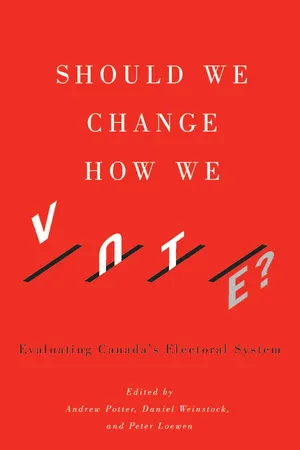
eBook - ePub
Should We Change How We Vote?
Evaluating Canada's Electoral System
- English
- ePUB (mobile friendly)
- Available on iOS & Android
eBook - ePub
Should We Change How We Vote?
Evaluating Canada's Electoral System
About this book
Information
Publisher
McGill-Queen's University PressYear
2017Print ISBN
9780773548824
9780773550629
eBook ISBN
9780773550834
Table of contents
- Cover
- Title Page
- Copyright
- Contents
- Acknowledgments
- Preface: A Note from Charles Bronfman
- Introduction: The History and Politics of Electoral Reform
- Part One: Guiding Principles
- Part Two: Evidence and Experience
- Part Three: Issues and Alternatives
- Part Four: How Should We Decide?
- Notes
- Contributors
Trusted by 375,005 students
Access to over 1.5 million titles for a fair monthly price.
Study more efficiently using our study tools.
Frequently asked questions
Yes, you can cancel anytime from the Subscription tab in your account settings on the Perlego website. Your subscription will stay active until the end of your current billing period. Learn how to cancel your subscription
No, books cannot be downloaded as external files, such as PDFs, for use outside of Perlego. However, you can download books within the Perlego app for offline reading on mobile or tablet. Learn how to download books offline
Perlego offers two plans: Essential and Complete
- Essential is ideal for learners and professionals who enjoy exploring a wide range of subjects. Access the Essential Library with 800,000+ trusted titles and best-sellers across business, personal growth, and the humanities. Includes unlimited reading time and Standard Read Aloud voice.
- Complete: Perfect for advanced learners and researchers needing full, unrestricted access. Unlock 1.5M+ books across hundreds of subjects, including academic and specialized titles. The Complete Plan also includes advanced features like Premium Read Aloud and Research Assistant.
We are an online textbook subscription service, where you can get access to an entire online library for less than the price of a single book per month. With over 1.5 million books across 990+ topics, we’ve got you covered! Learn about our mission
Look out for the read-aloud symbol on your next book to see if you can listen to it. The read-aloud tool reads text aloud for you, highlighting the text as it is being read. You can pause it, speed it up and slow it down. Learn more about Read Aloud
Yes! You can use the Perlego app on both iOS and Android devices to read anytime, anywhere — even offline. Perfect for commutes or when you’re on the go.
Please note we cannot support devices running on iOS 13 and Android 7 or earlier. Learn more about using the app
Please note we cannot support devices running on iOS 13 and Android 7 or earlier. Learn more about using the app
Yes, you can access Should We Change How We Vote? by Andrew Potter, Daniel M. Weinstock, Peter Loewen, Andrew Potter,Daniel M. Weinstock,Peter Loewen in PDF and/or ePUB format, as well as other popular books in Politics & International Relations & Global Politics. We have over 1.5 million books available in our catalogue for you to explore.