In recent years the circumpolar region has emerged as the key to understanding global climate change. The plight of the polar bear, resource extraction debates, indigenous self-determination, and competing definitions of sovereignty among Arctic nation-states have brought the northernmost part of the planet to the forefront of public consideration. Yet little is reported about the social world of environmental scientists in the Arctic. What happens at the isolated sites where experts seek to answer the most pressing questions facing the future of humanity?
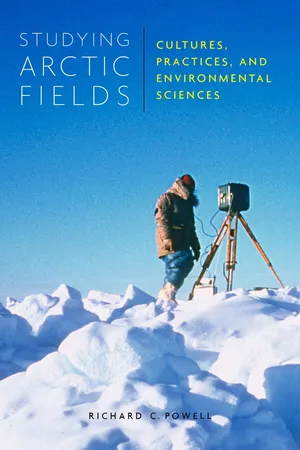
Portraying the social lives of scientists at Resolute in Nunavut and their interactions with logistical staff and Inuit, Richard Powell demonstrates that the scientific community is structured along power differentials in response to gender, class, and race. To explain these social dynamics the author examines the history and vision of the Government of Canada’s Polar Continental Shelf Program and John Diefenbaker’s “Northern Vision,” combining ethnography with wider discourses on nationalism, identity, and the postwar evolution of scientific sovereignty in the high Arctic. By revealing an expanded understanding of the scientific life as it relates to politics, history, and cultures, Studying Arctic Fields articulates a new theory of field research.
Advocating for a greater appreciation of science in the remote parts of the world, Studying Arctic Fields is an innovative approach to anthropology, environmental inquiry, and geography, and a landmark statement on Arctic science as a social practice.
- English
- ePUB (mobile friendly)
- Available on iOS & Android
eBook - ePub
About this book
Trusted by 375,005 students
Access to over 1.5 million titles for a fair monthly price.
Study more efficiently using our study tools.
Information
Table of contents
- Cover
- Half title
- Title
- Copyright
- Dedication
- Contents
- Figures
- Prologue
- Acknowledgments
- Introduction
- 1 Scientific Sovereignty, Nordicity, and the Canadian Nation
- 2 Between Observation and Experiment in Arctic Fieldwork
- 3 Base Cultures: The Spatial Organization of a Research Station
- 4 Performing the Arctic Scientific Human
- 5 Canada Day in Qausuittuq: Dramatizing Inuit Encounters
- 6 Emotional Practices and Play: The Quotidian Provenance of Logistics
- 7 Hidden Voices? Competing Visions and the Everyday Governance of Arctic Science
- Epilogue: Requiem for a Canadian Arctic?
- Note on Methodology, Sources, and Research Ethics
- Notes
- References
- Index
Frequently asked questions
Yes, you can cancel anytime from the Subscription tab in your account settings on the Perlego website. Your subscription will stay active until the end of your current billing period. Learn how to cancel your subscription
No, books cannot be downloaded as external files, such as PDFs, for use outside of Perlego. However, you can download books within the Perlego app for offline reading on mobile or tablet. Learn how to download books offline
Perlego offers two plans: Essential and Complete
- Essential is ideal for learners and professionals who enjoy exploring a wide range of subjects. Access the Essential Library with 800,000+ trusted titles and best-sellers across business, personal growth, and the humanities. Includes unlimited reading time and Standard Read Aloud voice.
- Complete: Perfect for advanced learners and researchers needing full, unrestricted access. Unlock 1.5M+ books across hundreds of subjects, including academic and specialized titles. The Complete Plan also includes advanced features like Premium Read Aloud and Research Assistant.
We are an online textbook subscription service, where you can get access to an entire online library for less than the price of a single book per month. With over 1.5 million books across 990+ topics, we’ve got you covered! Learn about our mission
Look out for the read-aloud symbol on your next book to see if you can listen to it. The read-aloud tool reads text aloud for you, highlighting the text as it is being read. You can pause it, speed it up and slow it down. Learn more about Read Aloud
Yes! You can use the Perlego app on both iOS and Android devices to read anytime, anywhere — even offline. Perfect for commutes or when you’re on the go.
Please note we cannot support devices running on iOS 13 and Android 7 or earlier. Learn more about using the app
Please note we cannot support devices running on iOS 13 and Android 7 or earlier. Learn more about using the app
Yes, you can access Studying Arctic Fields by Richard C. Powell in PDF and/or ePUB format, as well as other popular books in Social Sciences & Anthropology. We have over 1.5 million books available in our catalogue for you to explore.