In the summer of 2013, just as a small town in Quebec was decimated due to a train derailment, heavy rainfall prompted thirty Alberta communities to declare a state of emergency. Whereas a SWAT team surrounded train conductor Thomas Harding and brought him to court where he was charged with the deaths of forty-seven in Quebec, Calgary mayor Naheed Nenshi emerged from the Alberta crisis as a folk hero.
As the Lac-Mégantic train derailment and the flood in Alberta demonstrate, political, economic, legal, and cultural climates influence the way disasters are received and managed. In Too Critical to Fail, Kevin Quigley, Ben Bisset, and Bryan Mills identify the social context that shapes the Canadian government’s ability to prepare for and respond to emergencies. Using original research on natural disasters, pandemics, industrial failures, cyber-attacks, and terrorist threats, the authors evaluate the risk regulation regimes that monitor, interpret, and respond to failures in Canada’s critical infrastructure to limit their possibilities and consequences. More broadly, this book identifies key vulnerabilities and regulatory challenges for both the government and the private sector in mitigating threats to safety and security.
Too Critical to Fail applies an investigative lens to the multiple and competing risks that the government balances to secure assets that enable modern civilization. Raising questions about Canadians’ ability to protect critical infrastructure and respond to threats, this book challenges the biases that determine who is held to account when the system fails.
eBook - ePub
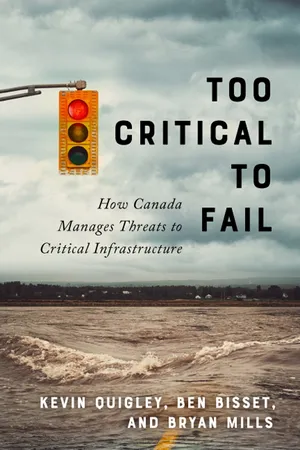
Too Critical to Fail
How Canada Manages Threats to Critical Infrastructure
- English
- ePUB (mobile friendly)
- Available on iOS & Android
eBook - ePub
Too Critical to Fail
How Canada Manages Threats to Critical Infrastructure
About this book
Information
Publisher
McGill-Queen's University PressYear
2017Print ISBN
9780773551619
9780773551602
eBook ISBN
9780773552609
Table of contents
- Cover
- Copyright
- Contents
- Tables and Figures
- Acknowledgments
- Abbreviations
- 1 Introduction
- PART ONE Situating the Study
- 2 Risk Governance and Critical Infrastructure: Control and Adaptive Capacity
- 3 Government and Critical Infrastructure Protection: Relevant but Not Responsible
- PART TWO Regime Content – Case Studies
- 4 Transportation Sector
- 5 Chemicals Sector
- PART THREE Regime Context – Pressures and Explanations
- 6 The Market Failure Hypothesis: Markets on the Margins
- 7 The Opinion-Responsive Hypothesis: Fascination and Aversion
- 8 “Cyber Gurus”: How Professionals Frame Cyber Threats
- 9 Pandemic Pandemonium: Canada’s Volatile Response to H1N1
- 10 The Interest Group Hypothesis: The Concentration of Power
- 11 Values and Institutions: Organizational Culture and Risk Response
- 12 Conclusion
- APPENDICES
- APPENDIX ONE Methods
- APPENDIX TWO Interview Participants
- APPENDIX THREE Media Events Studied
- APPENDIX FOUR Significant Privatizations in Canada, 1975–2011
- Notes
- References
- Index
Trusted by 375,005 students
Access to over 1.5 million titles for a fair monthly price.
Study more efficiently using our study tools.
Frequently asked questions
Yes, you can cancel anytime from the Subscription tab in your account settings on the Perlego website. Your subscription will stay active until the end of your current billing period. Learn how to cancel your subscription
No, books cannot be downloaded as external files, such as PDFs, for use outside of Perlego. However, you can download books within the Perlego app for offline reading on mobile or tablet. Learn how to download books offline
Perlego offers two plans: Essential and Complete
- Essential is ideal for learners and professionals who enjoy exploring a wide range of subjects. Access the Essential Library with 800,000+ trusted titles and best-sellers across business, personal growth, and the humanities. Includes unlimited reading time and Standard Read Aloud voice.
- Complete: Perfect for advanced learners and researchers needing full, unrestricted access. Unlock 1.5M+ books across hundreds of subjects, including academic and specialized titles. The Complete Plan also includes advanced features like Premium Read Aloud and Research Assistant.
We are an online textbook subscription service, where you can get access to an entire online library for less than the price of a single book per month. With over 1.5 million books across 990+ topics, we’ve got you covered! Learn about our mission
Look out for the read-aloud symbol on your next book to see if you can listen to it. The read-aloud tool reads text aloud for you, highlighting the text as it is being read. You can pause it, speed it up and slow it down. Learn more about Read Aloud
Yes! You can use the Perlego app on both iOS and Android devices to read anytime, anywhere — even offline. Perfect for commutes or when you’re on the go.
Please note we cannot support devices running on iOS 13 and Android 7 or earlier. Learn more about using the app
Please note we cannot support devices running on iOS 13 and Android 7 or earlier. Learn more about using the app
Yes, you can access Too Critical to Fail by Ben Bisset,Bryan Mills,Ken Quigley,Kevin Quigley in PDF and/or ePUB format, as well as other popular books in Politics & International Relations & Public Affairs & Administration. We have over 1.5 million books available in our catalogue for you to explore.