Politicians and citizens universally agree that Canada’s urban infrastructure urgently needs work. Roads and bridges are overdue for repair, aging water systems should be replaced, sewage must be adequately treated, urban transit needs to be updated and extended, and it is necessary that public housing as well as schools, health centres, and government offices are brought up to current standards. But few cities have room to raise additional revenue, and the federal and provincial governments to which they turn for financial support are already in deficit, so who is going to pay for all of this?
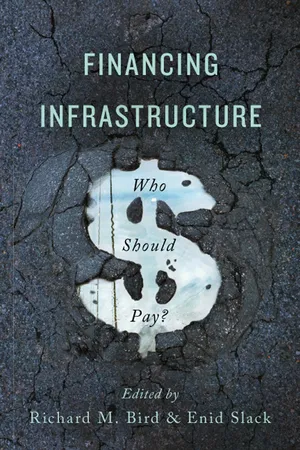
Bringing together perspectives and case studies from across Canada, the US, and Europe, Financing Infrastructure argues that the answer to the question “Who should pay?” should always be “users.” Headed by two of Canada’s foremost experts on municipal finance, this book provides a closer look at why charging user fees makes sense, how much users should pay, how to charge fees well and where present processes can be improved, and how to convince the politicians and the public of the importance of pricing infrastructure correctly.
Across the disciplines of public policy, urban studies, and economics, almost no one is looking at the extent to which users should play a role in infrastructure planning. Financing Infrastructure contends that the users, not federal and provincial taxpayers, should start paying directly for their cities’ repairs and expansions.
Contributors include Richard M. Bird (University of Toronto), Bernard Dafflon (University of Fribourg, Switzerland), Robert D. Ebel (Local Governance Innovation and Development), Harry Kitchen (Trent University), Jean-Philippe Meloche (Université de Montréal), Matti Siemiatycki (University of Toronto), Enid Slack (University of Toronto), Almos T. Tassonyi (University of Calgary), Lindsay M. Tedds (University of Victoria), François Vaillancourt (Université de Montréal), and Yameng Wang (World Bank).
eBook - ePub
Financing Infrastructure
Who Should Pay?
- English
- ePUB (mobile friendly)
- Available on iOS & Android
eBook - ePub
About this book
Information
Publisher
McGill-Queen's University PressYear
2017Print ISBN
9780773551473
9780773551466
eBook ISBN
9780773552456
Table of contents
- Cover
- Half title
- Title
- Copyright
- Contents
- Tables and Figures
- Preface
- 1 Financing Urban Infrastructure: Should Users Pay?
- 2 Financing Urban Infrastructure in Canada: Overview, Trends, and Issues
- 3 Paying for Water in Ontario’s Cities: Where Have We Come from and Where Should We Go?
- 4 Financing Urban Infrastructure in Quebec: Use of Fees in the Water and Transportation Sectors
- 5 User Charges for Municipal Infrastructure in Western Canada
- 6 The Role of User Charges in Funding the Flow of US Infrastructure Services
- 7 Financing Environmental Infrastructures through Tariffs: The Polluter/User-Pays Principle, Swiss Way
- 8 The Role of User Fees in Urban Transportation Public–Private Partnerships: Canada in a Global Perspective
- 9 Why We Should but Don’t Pay the Right Prices for Urban Infrastructure
- References
- Contributors
- Index
Trusted by 375,005 students
Access to over 1.5 million titles for a fair monthly price.
Study more efficiently using our study tools.
Frequently asked questions
Yes, you can cancel anytime from the Subscription tab in your account settings on the Perlego website. Your subscription will stay active until the end of your current billing period. Learn how to cancel your subscription
No, books cannot be downloaded as external files, such as PDFs, for use outside of Perlego. However, you can download books within the Perlego app for offline reading on mobile or tablet. Learn how to download books offline
We are an online textbook subscription service, where you can get access to an entire online library for less than the price of a single book per month. With over 1.5 million books across 990+ topics, we’ve got you covered! Learn about our mission
Look out for the read-aloud symbol on your next book to see if you can listen to it. The read-aloud tool reads text aloud for you, highlighting the text as it is being read. You can pause it, speed it up and slow it down. Learn more about Read Aloud
Yes! You can use the Perlego app on both iOS and Android devices to read anytime, anywhere — even offline. Perfect for commutes or when you’re on the go.
Please note we cannot support devices running on iOS 13 and Android 7 or earlier. Learn more about using the app
Please note we cannot support devices running on iOS 13 and Android 7 or earlier. Learn more about using the app
Yes, you can access Financing Infrastructure by Richard M. Bird, Enid Slack, Richard M. Bird,Enid Slack in PDF and/or ePUB format, as well as other popular books in Politica e relazioni internazionali & Pianificazione e sviluppo urbano. We have over 1.5 million books available in our catalogue for you to explore.