Most scholars have focused on The Second Sex and Simone de Beauvoir’s fiction, concentrating on gender issues but ignoring her broader emancipatory vision. Though Beauvoir’s political thinking is not as closely studied as her feminist works, it underpinned her activism and helped her navigate the dilemmas raised by revolutionary thought in the postwar period. In Emancipatory Thinking Elaine Stavro brings together Beauvoir’s philosophy and her political interventions to produce complex ideas on emancipation.
Drawing from a range of work, including novels, essays, autobiographical writings, and philosophic texts, Stavro explains that for Beauvoir freedom is a movement that requires both personal and collective transformation. Freedom is not guaranteed by world historical systems, material structures, wilful action, or discursive practices, but requires engaged subjects who are able to take creative risks as well as synchronize with existing forces to work towards collective change. Beauvoir, Stavro asserts, resisted the trend of anti-humanism that has dominated French thinking since the 1960s and also managed to avoid the pitfalls of voluntarism and individualism. In fact, Stavro argues, Beauvoir appreciated the impact of material, socio-economic, institutional forces, without forgoing the capacity to initiate.
Applying Beauvoir’s existential insights and understanding of embodied and situated subjectivity to recent debates within gender, literary, sociological, cultural, and political studies, Emancipatory Thinking provides a lens to explore the current political and theoretical landscape.
eBook - ePub
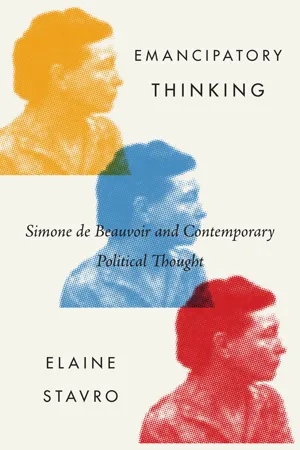
Emancipatory Thinking
Simone de Beauvoir and Contemporary Political Thought
- English
- ePUB (mobile friendly)
- Available on iOS & Android
eBook - ePub
About this book
Information
Publisher
McGill-Queen's University PressYear
2018Print ISBN
9780773553552
9780773553545
eBook ISBN
9780773553927
Topic
FilosofíaSubtopic
Filosofía políticaTable of contents
- Cover
- Copyright
- Contents
- Acknowledgments
- Introduction
- 1 Feminism and Epistemology: Debunking Male Epistemic Privilege
- 2 Rethinking the Sex/Gender Distinction
- 3 Beauvoir Reconfigures Social Subjectivity in the Wake of Psychoanalysis
- 4 Beauvoir’s Political Thinking: The Entwining of Existentialism and Marxism
- 5 Broadening Emancipatory Struggles: Encounters with Social Movements, Revolutionary Regimes, and the Media
- 6 Rethinking the Role of the Critical Intellectual: Liberating or Colonizing?
- 7 Fictions of Politics: Affect, Idea, and Engagement
- Conclusion
- References
- Index
Trusted by 375,005 students
Access to over 1.5 million titles for a fair monthly price.
Study more efficiently using our study tools.
Frequently asked questions
Yes, you can cancel anytime from the Subscription tab in your account settings on the Perlego website. Your subscription will stay active until the end of your current billing period. Learn how to cancel your subscription
No, books cannot be downloaded as external files, such as PDFs, for use outside of Perlego. However, you can download books within the Perlego app for offline reading on mobile or tablet. Learn how to download books offline
Perlego offers two plans: Essential and Complete
- Essential is ideal for learners and professionals who enjoy exploring a wide range of subjects. Access the Essential Library with 800,000+ trusted titles and best-sellers across business, personal growth, and the humanities. Includes unlimited reading time and Standard Read Aloud voice.
- Complete: Perfect for advanced learners and researchers needing full, unrestricted access. Unlock 1.5M+ books across hundreds of subjects, including academic and specialized titles. The Complete Plan also includes advanced features like Premium Read Aloud and Research Assistant.
We are an online textbook subscription service, where you can get access to an entire online library for less than the price of a single book per month. With over 1.5 million books across 990+ topics, we’ve got you covered! Learn about our mission
Look out for the read-aloud symbol on your next book to see if you can listen to it. The read-aloud tool reads text aloud for you, highlighting the text as it is being read. You can pause it, speed it up and slow it down. Learn more about Read Aloud
Yes! You can use the Perlego app on both iOS and Android devices to read anytime, anywhere — even offline. Perfect for commutes or when you’re on the go.
Please note we cannot support devices running on iOS 13 and Android 7 or earlier. Learn more about using the app
Please note we cannot support devices running on iOS 13 and Android 7 or earlier. Learn more about using the app
Yes, you can access Emancipatory Thinking by Elaine Stavro in PDF and/or ePUB format, as well as other popular books in Filosofía & Filosofía política. We have over 1.5 million books available in our catalogue for you to explore.