Global environmental destruction, growing inequality, and the persistent poverty afflicting the majority of humans on the planet challenge Christian theorists, theologians, and ethicists in their pursuit of an ethical vision that is both environmentally sustainable and just for all of creation. Too often their visions - which start with traditional understandings of the Christian faith, prevalent approaches to science, or current ethical models - are inadequate.
In Convergent Knowing Simon Appolloni proposes a new framework for ethical deliberation in which the epistemological lines between religion and science are somewhat blurred. This framework opens up avenues to explore new paradigms for Christianity, science, and liberation while addressing interrelated questions not always manifest within the religion, science, and ethics debates: what kind of ethics, what kind of science, and what kind of Christianity do we need today and tomorrow when the liberation of countless subjects of creation is at stake?
Exploring and analyzing the work of Rosemary Radford Ruether, Leonardo Boff, Diarmuid O'Murchu, and Thomas Berry, four Christian ethical thinkers who have borrowed from the natural sciences to unite a liberationist agenda with an environmental ethic, Convergent Knowing assists Christian thinkers struggling to integrate science, environment, liberation, and their faith.
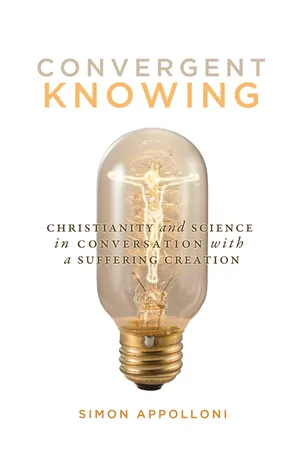
eBook - ePub
Convergent Knowing
Christianity and Science in Conversation with a Suffering Creation
- English
- ePUB (mobile friendly)
- Available on iOS & Android
eBook - ePub
Convergent Knowing
Christianity and Science in Conversation with a Suffering Creation
About this book
Information
Publisher
McGill-Queen's University PressYear
2018Print ISBN
9780773554443
9780773554436
eBook ISBN
9780773555624
Topic
Theology & ReligionSubtopic
ChristianityTable of contents
- Cover
- Title Page
- Copyright
- Contents
- Acknowledgments
- Preface
- Introduction: Getting Serious about the Liberation of All Creation
- Part One Delineating the Particular Contribution of Each Thinker
- Part Two Weaving a Communal Conversation
- Conclusion: A Post-Normal Christianity?
- Notes
- Bibliography
- Index
Trusted by 375,005 students
Access to over 1.5 million titles for a fair monthly price.
Study more efficiently using our study tools.
Frequently asked questions
Yes, you can cancel anytime from the Subscription tab in your account settings on the Perlego website. Your subscription will stay active until the end of your current billing period. Learn how to cancel your subscription
No, books cannot be downloaded as external files, such as PDFs, for use outside of Perlego. However, you can download books within the Perlego app for offline reading on mobile or tablet. Learn how to download books offline
Perlego offers two plans: Essential and Complete
- Essential is ideal for learners and professionals who enjoy exploring a wide range of subjects. Access the Essential Library with 800,000+ trusted titles and best-sellers across business, personal growth, and the humanities. Includes unlimited reading time and Standard Read Aloud voice.
- Complete: Perfect for advanced learners and researchers needing full, unrestricted access. Unlock 1.5M+ books across hundreds of subjects, including academic and specialized titles. The Complete Plan also includes advanced features like Premium Read Aloud and Research Assistant.
We are an online textbook subscription service, where you can get access to an entire online library for less than the price of a single book per month. With over 1.5 million books across 990+ topics, we’ve got you covered! Learn about our mission
Look out for the read-aloud symbol on your next book to see if you can listen to it. The read-aloud tool reads text aloud for you, highlighting the text as it is being read. You can pause it, speed it up and slow it down. Learn more about Read Aloud
Yes! You can use the Perlego app on both iOS and Android devices to read anytime, anywhere — even offline. Perfect for commutes or when you’re on the go.
Please note we cannot support devices running on iOS 13 and Android 7 or earlier. Learn more about using the app
Please note we cannot support devices running on iOS 13 and Android 7 or earlier. Learn more about using the app
Yes, you can access Convergent Knowing by Simon Appolloni in PDF and/or ePUB format, as well as other popular books in Theology & Religion & Christianity. We have over 1.5 million books available in our catalogue for you to explore.