The importance of research on the notion of trust has grown considerably in the social sciences over the last three decades. Much has been said about the decline of political trust in democracies and intense debates have occurred about the nature and complexity of the relationship between trust and democracy. Political trust is usually understood as trust in political institutions (including trust in political actors that inhabit the institutions), trust between citizens, and to a lesser extent, trust between groups. However, the literature on trust has given no special attention to the issue of trust between minority and majority nations in multinational democracies - countries that are not only multicultural but also constitutional associations containing two or more nations or peoples whose members claim to be self-governing and have the right of self-determination.
This volume, part of the work of the Groupe de recherche sur les sociétés plurinationales (GRSP), is a comparative study of trust, distrust, and mistrust in multinational democracies, centring on Canada, Belgium, Spain, and the United Kingdom. Beliefs, attitudes, practices, and relations of trust, distrust, and mistrust are studied as situated, interacting, and coexisting phenomena that change over time and space.
Contributors include Dario Castiglione (Exeter), Jérôme Couture (INRS-UCS), Kris Deschouwer (Vrije Universiteit Brussel), Jean Leclair (Montréal), Patti Tamara Lenard (Ottawa), Niels Morsink (Antwerp), Geneviève Nootens (Chicoutimi), Darren O’Toole (Ottawa), Alexandre Pelletier (Toronto), Réjean Pelletier (Laval), Philip Resnick (UBC), David Robichaud (Ottawa), Peter Russell (Toronto), Richard Simeon (Toronto), Dave Sinardet (Vrije Universiteit Brussel), and Jeremy Webber (Victoria).
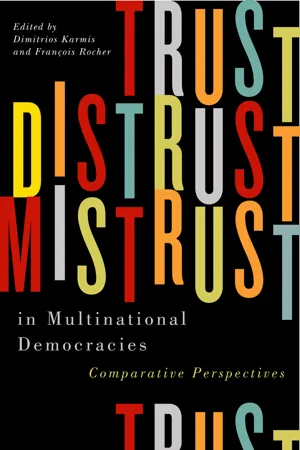
eBook - ePub
Trust, Distrust, and Mistrust in Multinational Democracies
Comparative Perspectives
- English
- ePUB (mobile friendly)
- Available on iOS & Android
eBook - ePub
Trust, Distrust, and Mistrust in Multinational Democracies
Comparative Perspectives
About this book
Information
Publisher
McGill-Queen's University PressYear
2018Print ISBN
9780773553439
9780773553422
eBook ISBN
9780773554344
Table of contents
- Cover
- Copyright
- Contents
- Tables and Figures
- INTRODUCTION The Language of Trust, Distrust, and Mistrust in Multinational Democracies
- PART ONE Theoretical Debates
- 1 Conceptions of Trust: From Social Mechanism to Normative Principle
- 2 Democracy, Trust, and National Identity
- 3 Trust: The Key to the Progressive’s Dilemma between Solidarity and Diversity?
- 4 Democratic Institutions and Representative Trust
- 5 Vigilance, Trust, and “Fine Risks” in the Minefield of Multinational Democracies
- PART TWO The Dynamics of Trust, Distrust, and Mistrust in Canada
- 6 The Conditional Nature of Trust in Canada’s Multinational Constitutional Politics
- 7 The Construction of Canada in Historical Perspective: Distrust as an Inherent Component of Constitutional Debates?
- 8 The Delayed (and Qualified) Victory of the Meech Lake Accord: The Role of Constitutional Reform in Undermining and Restoring Intercommunal Trust
- 9 Federalism as Rejection of Nationalist Monisms
- 10 Linguistic Groups and Civil Society: Trust, Cooperation, and Accommodation in Canadian Voluntary Associations
- PART THREE Comparative Perspectives
- 11 Through the Mirror of Contingency: Trust and Mistrust in Multinational States
- 12 Identity and Political Trust in Multinational Democracies: The Cases of Québec and Catalonia
- 13 Trust and Distrust in the Belgian Federation
- 14 Trust between Party Elites in Consociational Federations: The Case of Belgium
- Contributors
- Index
Trusted by 375,005 students
Access to over 1.5 million titles for a fair monthly price.
Study more efficiently using our study tools.
Frequently asked questions
Yes, you can cancel anytime from the Subscription tab in your account settings on the Perlego website. Your subscription will stay active until the end of your current billing period. Learn how to cancel your subscription
No, books cannot be downloaded as external files, such as PDFs, for use outside of Perlego. However, you can download books within the Perlego app for offline reading on mobile or tablet. Learn how to download books offline
Perlego offers two plans: Essential and Complete
- Essential is ideal for learners and professionals who enjoy exploring a wide range of subjects. Access the Essential Library with 800,000+ trusted titles and best-sellers across business, personal growth, and the humanities. Includes unlimited reading time and Standard Read Aloud voice.
- Complete: Perfect for advanced learners and researchers needing full, unrestricted access. Unlock 1.5M+ books across hundreds of subjects, including academic and specialized titles. The Complete Plan also includes advanced features like Premium Read Aloud and Research Assistant.
We are an online textbook subscription service, where you can get access to an entire online library for less than the price of a single book per month. With over 1.5 million books across 990+ topics, we’ve got you covered! Learn about our mission
Look out for the read-aloud symbol on your next book to see if you can listen to it. The read-aloud tool reads text aloud for you, highlighting the text as it is being read. You can pause it, speed it up and slow it down. Learn more about Read Aloud
Yes! You can use the Perlego app on both iOS and Android devices to read anytime, anywhere — even offline. Perfect for commutes or when you’re on the go.
Please note we cannot support devices running on iOS 13 and Android 7 or earlier. Learn more about using the app
Please note we cannot support devices running on iOS 13 and Android 7 or earlier. Learn more about using the app
Yes, you can access Trust, Distrust, and Mistrust in Multinational Democracies by Dimitrios Karmis, François Rocher, Dimitrios Karmis,François Rocher in PDF and/or ePUB format, as well as other popular books in Politique et relations internationales & Politique comparée. We have over 1.5 million books available in our catalogue for you to explore.