Since the 1980s the study of genocide has exploded, both historically and geographically, to encompass earlier epochs, other continents, and new cases. The concept of genocide has proved its worth, but that expansion has also compounded the tensions between a rigid legal concept and the manifold realities researchers have discovered. The legal and political benefits that accompany genocide status have also reduced complex discussions of historical events to a simplistic binary – is it genocide or not? – a situation often influenced by powerful political pressures.
Genocide addresses these tensions and tests the limits of the concept in cases ranging from the role of sexual violence during the Holocaust to state-induced mass starvation in Kazakh and Ukrainian history, while considering what the Armenian, Rwandan, and Burundi experiences reveal about the uses and pitfalls of reading history and conducting politics through the lens of genocide. Contributors examine the pressures that great powers have exerted in shaping the concept; the reaction Raphaël Lemkin, originator of the word "genocide," had to the United Nations' final resolution on the subject; France's long-held choice not to use the concept of genocide in its courtrooms; the role of transformative social projects and use of genocide memory in politics; and the relation of genocide to mass violence targeting specific groups.
Throughout, this comprehensive text offers innovative solutions to address the limitations of the genocide concept, while preserving its usefulness as an analytical framework.
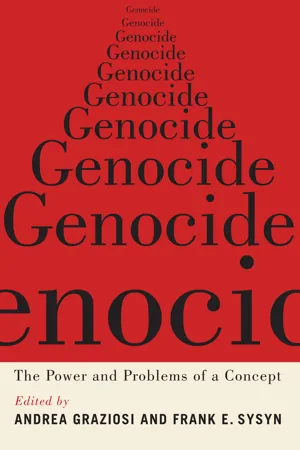
eBook - ePub
Genocide
The Power and Problems of a Concept
- 272 pages
- English
- ePUB (mobile friendly)
- Available on iOS & Android
eBook - ePub
Genocide
The Power and Problems of a Concept
About this book
Information
Publisher
McGill-Queen's University PressYear
2022Print ISBN
9780228011712
9780228008347
eBook ISBN
9780228009528
Table of contents
- Cover Page
- Title Page
- Copyright
- Contents
- Acknowledgments
- Introduction: Genocide and Mass Categorical Violence
- 1 Somebody Else’s Crime: The Drafting of the Genocide Convention as a Cold War Battle, 1946–48
- 2 The Costs of Silencing Holocaust Victims: Why We Must Add Sexual Violence to Our Definition of Genocide
- 3 Frames and Narratives: How the Fates of the Ottoman Armenians, Stalin-Era Ukrainians, and Kazakhs Illuminate the Concept of Genocide
- 4 The Holodomor in the Context of Soviet Mass Killing in the 1930s
- 5 The Kazakh Famine, the Holodomor, and the Soviet Famines of 1930–33: Starvation and National Un-building in the Soviet Union
- 6 The “Lemkin Turn” in Ukrainian Studies: Genocide, Peoples, Nations, and Empire
- 7 The Orchestrated Inapplicability of the Law of Crimes against Humanity and Genocide – une exception française?
- 8 Is It Time to Forget Genocide? Conceptual Problems and New Directions
- 9 The Limits of a Genocide Lens and Possible Alternatives
- Contributors
- Index
Trusted by 375,005 students
Access to over 1.5 million titles for a fair monthly price.
Study more efficiently using our study tools.
Frequently asked questions
Yes, you can cancel anytime from the Subscription tab in your account settings on the Perlego website. Your subscription will stay active until the end of your current billing period. Learn how to cancel your subscription
No, books cannot be downloaded as external files, such as PDFs, for use outside of Perlego. However, you can download books within the Perlego app for offline reading on mobile or tablet. Learn how to download books offline
Perlego offers two plans: Essential and Complete
- Essential is ideal for learners and professionals who enjoy exploring a wide range of subjects. Access the Essential Library with 800,000+ trusted titles and best-sellers across business, personal growth, and the humanities. Includes unlimited reading time and Standard Read Aloud voice.
- Complete: Perfect for advanced learners and researchers needing full, unrestricted access. Unlock 1.5M+ books across hundreds of subjects, including academic and specialized titles. The Complete Plan also includes advanced features like Premium Read Aloud and Research Assistant.
We are an online textbook subscription service, where you can get access to an entire online library for less than the price of a single book per month. With over 1.5 million books across 990+ topics, we’ve got you covered! Learn about our mission
Look out for the read-aloud symbol on your next book to see if you can listen to it. The read-aloud tool reads text aloud for you, highlighting the text as it is being read. You can pause it, speed it up and slow it down. Learn more about Read Aloud
Yes! You can use the Perlego app on both iOS and Android devices to read anytime, anywhere — even offline. Perfect for commutes or when you’re on the go.
Please note we cannot support devices running on iOS 13 and Android 7 or earlier. Learn more about using the app
Please note we cannot support devices running on iOS 13 and Android 7 or earlier. Learn more about using the app
Yes, you can access Genocide by Andrea Graziosi, Frank E. Sysyn, Andrea Graziosi,Frank E. Sysyn in PDF and/or ePUB format, as well as other popular books in Politics & International Relations & Genocide & War Crimes. We have over 1.5 million books available in our catalogue for you to explore.