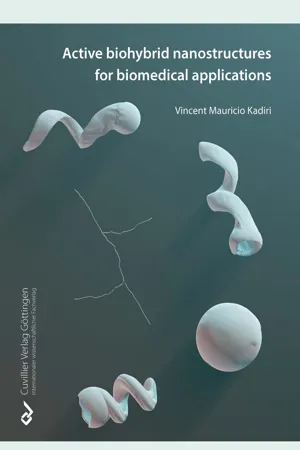
Nanostructures, especially biohybrid nanostructures have long been imagined as promising carriers in (bio)medical applications such as drug and gene delivery. However, few nanomedical applications, apart from liposomes, have seen widespread adoption. All available biomedical nanosystems to date rely on passive diffusion for their dispersal and very few studies demonstrate chemical targeting. Nature, on the other hand, has evolved many ways of combining highly specific targeting and active microscale motion, e.g., chemotaxis, magnetotaxis, and phototaxis of bacteria and microorganisms. In order to realize synthetic nanostructures and systems that can rival natural ones, a number of challenges still lie ahead of us.In this thesis, the author introduces examples of bioinspired and biohybrid nanostructures that address some of these challenges. Two material platforms are developed in this thesis, one based on M13 bacteriophages and one on FePt-based nanomotors. These systems can be viewed as very different but equally promising active biohybrid nanostructures. The introduced active biohybrid nanostructures are completely biocompatible and in the case of FePt nanodevices also enable precise actuated motion and targeting. The tools presented in this thesis are general and may help in the development of new biohybrid nanodevices for biomedical applications and therapies.Biohybride Nanostrukturen sind vielversprechende Technologien für biomedizinische Anwendungen, wie den gerichteten Transport von Pharmazeutika und Genen im Körper. Mit Ausnahme von Liposomen finden jedoch nur wenige Nanosyteme bislang ihren Weg in die medizinische Anwendung. Bisher verfügbare Nanosysteme sind meist auf passive Diffusion für die Verteilung im Körper angewiesen und nur sehr wenige Studien verwenden chemisches Targeting. In der Natur hingegen haben sich viele Möglichkeiten entwickelt, die hochspezifisches Targeting und aktive Bewegung im Mikrobereich kombinieren, z.B. Chemotaxis, Magnetotaxis und Phototaxis von Bakterien und Mikroorganismen. Um synthetische Nanostrukturen und -systeme zu realisieren, die mit natürlichen konkurrieren können, stehen also noch eine Reihe an Herausforderungen vor uns.Um diese Herausforderungen zu adressieren, stellt diese Arbeit zwei bioinspirierte und biohybride Nanosysteme vor: eins auf der Grundlage von M13 Bakteriophagen und eins auf FePt basierten Nanomotoren. Die zwei Systeme können als sehr unterschiedliche, aber gleichermaßen vielversprechende ktive biohybride Nanostrukturen betrachtet werden. Die aktiven biohybrider Nanostrukturen sind vollständig biokompatibel und ermöglichen im Fall von FePt Nanoschwimmern präzise Fernsteuerung. Die in dieser Arbeit vorgestellten Nanostrukturen und -werkzeuge sind allgemeiner Natur und könnten bei der Entwicklung neuer biohybrider Nanosysteme für biomedizinische Anwendungen und Therapien helfen.
- 199 pages
- English
- PDF
- Available on iOS & Android
eBook - PDF
Active Biohybrid Nanostructures For Biomedical Applications
About this book
Information
Print ISBN
9783736975507
Edition
1Table of contents
- LIST OF SYMBOLS AND ABBREVIATIONS
- LIST OF PUBLICATIONS
- ABSTRACT
- ZUSAMMENFASSUNG
- Part I PREFACE
- 1 INTRODUCTION
- 2 THEORETICAL BACKGROUND ON BIOCOMPATIBLE L1 0IRON-PLATINUM NANODEVICES
- 2.1 swimming at low reynolds numbers
- 2.2 glancing angle deposition
- 2.3 iron-platinum ferromagnetism
- 2.4 squid magnetometry
- 2.5 mass transport pathways across the cell membrane
- 3 THEORETICAL BACKGROUND ON BIODEGRADABLEPROPELLERS FOR GENE THERAPY
- 3.1 biomedical devices based on magnesium and zinc
- 3.2 viral gene therapy
- 4 THEORETICAL BACKGROUND ON M13 BACTERIOPHAGESELF-ASSEMBLY
- 4.1 m13 bacteriophages
- 4.2 m13 bacteriophages for enzyme catalysis
- 4.3 self-assembly and dna origami
- Part II BIOCOMPATIBLE L1 0 IRON-PLATINUMNANODEVICES
- 5 BIOCOMPATIBLE MAGNETIC MICRO- AND NANODEVICES:FABRICATION OF IRON-PLATINUM NANOPROPELLERS ANDCELL TRANSFECTION
- Supporting Information iron-platinum nanopropellers and cell transfection
- 6 LIGHT- AND MAGNETICALLY ACTUATED IRON-PLATINUMMICROSWIMMERS
- Part III BIODEGRADABLE PROPELLERS FOR GENETHERAPY
- 7 BIODEGRADABLE MAGNESIUM-ZINC MAGNETICALLYACTUATED NANOPROPELLERS FOR NON-VIRALTRANSFECTION
- 7.1 introduction
- 7.2 discussion and results
- 7.3 methods
- Part IV M13 BACTERIOPHAGE SELF-ASSEMBLY
- 8 GENETICALLY MODIFIED M13 BACTERIOPHAGE NANONETSFOR ENZYME CATALYSIS AND RECOVERY
- Supporting Information m13 bacteriophage nanonets for enzyme catalysis
- Part V CONCLUSION
- 9 CONCLUSION
- ACKNOWLEDGMENTS
- BIBLIOGRAPHY
Trusted by 375,005 students
Access to over 1.5 million titles for a fair monthly price.
Study more efficiently using our study tools.