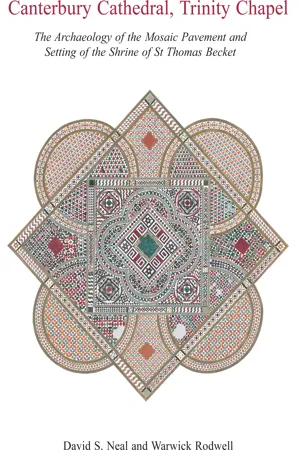
Canterbury Cathedral possesses a unique marble mosaic pavement, dating from the early twelfth century, which has long intrigued scholars and been the subject of speculation and debate. It forms part of the floor of the Trinity chapel, adjacent to the site where the shrine of St Thomas Becket stood, prior to the Reformation. Since the mosaic is older than the chapel itself and partly destroyed a pavement of figurative roundels, laid c. 1215, it must have been moved here from elsewhere in the cathedral. This volume explores the history and archaeology of the Trinity chapel, the pavement and the physical remains of the cult of Becket, based largely on hitherto unrecorded and unpublished evidence. In the early twelfth century, Archbishop Anselm rebuilt the eastern arm of the cathedral, introducing architectural elements from his native Italy, and these included a magnificent mosaic pavement, composed of the most expensive marbles, which lay in front of the high altar. In 1170, Archbishop Becket was murdered in the cathedral, and his body rested overnight on the pavement before being buried in the crypt. Thomas was immediately revered as a martyr, and in 1173 was canonized by the pope; a simple shrine was erected over his tomb. In the following year, a fire (arson) destroyed the eastern arm of the cathedral, precipitating the construction of the present Trinity and Corona chapels, wherein St Thomas's remains were enshrined. After decades of delay and political strife, the enshrinement took place in 1220, in the presence of Henry III. The shrine comprised a great marble table, supported on six clusters of columns. On top of the table was a marble sarcophagus containing the saint's body in an iron-bound timber coffin, over which stood the sumptuous feretory, a gabled timber 'roof', plated with sheets of gold and adorned with jewels. East of the shrine lies the small Corona chapel in which a fragment of Becket's skull was separately encased in a 'head-shrine', and to the west a large area was paved with forty-eight figurative stone roundels, created by French artisans. All around, stained-glass windows display the early miracles of Becket. The layout of the Trinity chapel underwent transmutations, first around 1230, when the mosaic pavement was taken up from the old presbytery, reduced in size and relaid in front of Becket's shrine, where is it today. Second, the chapel was reordered in c. 1290, when the podium carrying the shrine was enlarged and the paving around it reconfigured. Medieval tombs were now being installed in the chapels, including those of the Black Prince and Henry IV. The end came in 1538, when Henry VIII ordered the thorough destruction of Becket's shrines, but a great deal of archaeological evidence remained in the floors, walls and a few surviving fragments of the shrines, all now recorded and discussed in this volume for the first time.
eBook - ePub
Canterbury Cathedral, Trinity Chapel
The Archaeology of the Mosaic Pavement and Setting of the Shrine of St Thomas Becket
- 416 pages
- English
- ePUB (mobile friendly)
- Available on iOS & Android
eBook - ePub
Canterbury Cathedral, Trinity Chapel
The Archaeology of the Mosaic Pavement and Setting of the Shrine of St Thomas Becket
About this book
Trusted by 375,005 students
Access to over 1.5 million titles for a fair monthly price.
Study more efficiently using our study tools.
Information
Subtopic
History of ArchitectureIndex
HistoryTable of contents
- Cover
- Title
- Copyright
- Dedication
- Contents
- Foreword by Professor Eric Fernie, CBE
- Preface
- Acknowledgements
- Summary
- INTRODUCTION
- PART 1 THE MOSAIC AND INLAID-ROUNDEL PAVEMENTS
- PART 2 THE TRINITY CHAPEL AND SHRINES OF ST THOMAS OF CANTERBURY
- Notes
- Abbreviations and bibliography
- Painting of the Romanesque mosaic pavement (fold-out at end of volume)
Frequently asked questions
Yes, you can cancel anytime from the Subscription tab in your account settings on the Perlego website. Your subscription will stay active until the end of your current billing period. Learn how to cancel your subscription
No, books cannot be downloaded as external files, such as PDFs, for use outside of Perlego. However, you can download books within the Perlego app for offline reading on mobile or tablet. Learn how to download books offline
Perlego offers two plans: Essential and Complete
- Essential is ideal for learners and professionals who enjoy exploring a wide range of subjects. Access the Essential Library with 800,000+ trusted titles and best-sellers across business, personal growth, and the humanities. Includes unlimited reading time and Standard Read Aloud voice.
- Complete: Perfect for advanced learners and researchers needing full, unrestricted access. Unlock 1.5M+ books across hundreds of subjects, including academic and specialized titles. The Complete Plan also includes advanced features like Premium Read Aloud and Research Assistant.
We are an online textbook subscription service, where you can get access to an entire online library for less than the price of a single book per month. With over 1.5 million books across 990+ topics, we’ve got you covered! Learn about our mission
Look out for the read-aloud symbol on your next book to see if you can listen to it. The read-aloud tool reads text aloud for you, highlighting the text as it is being read. You can pause it, speed it up and slow it down. Learn more about Read Aloud
Yes! You can use the Perlego app on both iOS and Android devices to read anytime, anywhere — even offline. Perfect for commutes or when you’re on the go.
Please note we cannot support devices running on iOS 13 and Android 7 or earlier. Learn more about using the app
Please note we cannot support devices running on iOS 13 and Android 7 or earlier. Learn more about using the app
Yes, you can access Canterbury Cathedral, Trinity Chapel by David S. Neal,Warwick Rodwell in PDF and/or ePUB format, as well as other popular books in History & History of Architecture. We have over 1.5 million books available in our catalogue for you to explore.