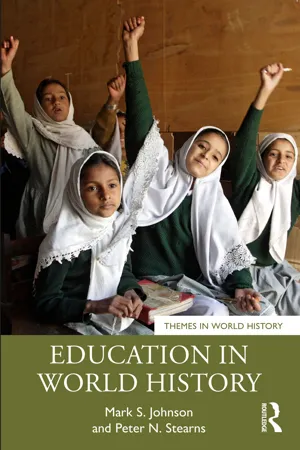
Education in World History
eBook - ePub

Education in World History

  1. 252 pages
  2. English
  3. ePUB (mobile friendly)
  4. Available on iOS & Android
eBook - ePub

Education in World History

About this book

Education in World History shows how broad currents in transnational history have interacted with trends in educational organization and teaching practices over time.

From antiquity and early classical societies to present day, this book highlights the ways in which changes in religious and intellectual life and economic patterns in key world regions have generated developments in education. Since the postclassical period, cross-cultural connections have also influenced educational change. In more recent times, transnational dialogues and mobility have played a vital role in shaping educational patterns. Ranging through South and East Asia, Africa, Europe and the Americas, the book also considers how the impact of modern forces, such as industrialization and nationalism, have transformed education in fundamental ways. Throughout the volume, Mark S. Johnson and Peter N. Stearns emphasize the tensions between elite and state educational interests and more diverse popular demands for access and, often, for more innovative pedagogy.

Suitable for introductory world history and history of education courses, this lively overview reconsiders the history of education from the perspective of world and comparative history.

Frequently asked questions

Yes, you can cancel anytime from the Subscription tab in your account settings on the Perlego website. Your subscription will stay active until the end of your current billing period. Learn how to cancel your subscription.
No, books cannot be downloaded as external files, such as PDFs, for use outside of Perlego. However, you can download books within the Perlego app for offline reading on mobile or tablet. Learn more here.
Perlego offers two plans: Essential and Complete
  • Essential is ideal for learners and professionals who enjoy exploring a wide range of subjects. Access the Essential Library with 800,000+ trusted titles and best-sellers across business, personal growth, and the humanities. Includes unlimited reading time and Standard Read Aloud voice.
  • Complete: Perfect for advanced learners and researchers needing full, unrestricted access. Unlock 1.4M+ books across hundreds of subjects, including academic and specialized titles. The Complete Plan also includes advanced features like Premium Read Aloud and Research Assistant.
Both plans are available with monthly, semester, or annual billing cycles.
We are an online textbook subscription service, where you can get access to an entire online library for less than the price of a single book per month. With over 1 million books across 1000+ topics, we’ve got you covered! Learn more here.
Look out for the read-aloud symbol on your next book to see if you can listen to it. The read-aloud tool reads text aloud for you, highlighting the text as it is being read. You can pause it, speed it up and slow it down. Learn more here.
Yes! You can use the Perlego app on both iOS or Android devices to read anytime, anywhere — even offline. Perfect for commutes or when you’re on the go.
Please note we cannot support devices running on iOS 13 and Android 7 or earlier. Learn more about using the app.
Yes, you can access Education in World History by Mark S. Johnson,Peter N. Stearns in PDF and/or ePUB format, as well as other popular books in History & Social History. We have over one million books available in our catalogue for you to explore.

Information

Publisher
Routledge
Year
2022
Print ISBN
9780415318143
eBook ISBN
9781317813378

Table of contents

  1. Cover
  2. Half-Title
  3. Series
  4. Title
  5. Copyright
  6. Contents
  7. Introduction: Linking World History and the History of Education
  8. PART I Education in Early Human Societies
  9. PART II The Postclassical Centuries
  10. PART III The Early Modern Period
  11. PART IV The Long Nineteenth Century and an Emerging Modern Framework for Education
  12. PART V The Contemporary Period
  13. Conclusion
  14. Index