Deep learning from the ground up using R and the powerful Keras library!
In Deep Learning with R, Second Edition you will learn:
Deep learning from first principles
Image classification and image segmentation
Time series forecasting
Text classification and machine translation
Text generation, neural style transfer, and image generation
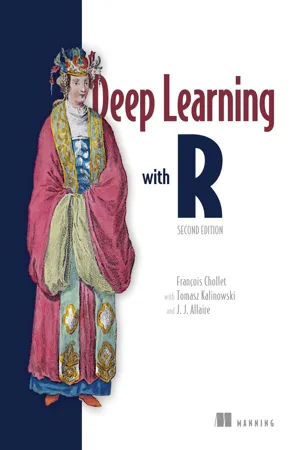
Deep Learning with R, Second Edition shows you how to put deep learning into action. It’s based on the revised new edition of François Chollet’s bestselling Deep Learning with Python. All code and examples have been expertly translated to the R language by Tomasz Kalinowski, who maintains the Keras and Tensorflow R packages at RStudio. Novices and experienced ML practitioners will love the expert insights, practical techniques, and important theory for building neural networks.
About the technology
Deep learning has become essential knowledge for data scientists, researchers, and software developers. The R language APIs for Keras and TensorFlow put deep learning within reach for all R users, even if they have no experience with advanced machine learning or neural networks. This book shows you how to get started on core DL tasks like computer vision, natural language processing, and more using R.
About the book
Deep Learning with R, Second Edition is a hands-on guide to deep learning using the R language. As you move through this book, you’ll quickly lock in the foundational ideas of deep learning. The intuitive explanations, crisp illustrations, and clear examples guide you through core DL skills like image processing and text manipulation, and even advanced features like transformers. This revised and expanded new edition is adapted from Deep Learning with Python, Second Edition by François Chollet, the creator of the Keras library.
What's inside
Image classification and image segmentation
Time series forecasting
Text classification and machine translation
Text generation, neural style transfer, and image generation
About the reader
For readers with intermediate R skills. No previous experience with Keras, TensorFlow, or deep learning is required.
About the author
François Chollet is a software engineer at Google and creator of Keras. Tomasz Kalinowski is a software engineer at RStudio and maintainer of the Keras and Tensorflow R packages. J.J. Allaire is the founder of RStudio, and the author of the first edition of this book.
Table of Contents
1 What is deep learning?
2 The mathematical building blocks of neural networks
3 Introduction to Keras and TensorFlow
4 Getting started with neural networks: Classification and regression
5 Fundamentals of machine learning
6 The universal workflow of machine learning
7 Working with Keras: A deep dive
8 Introduction to deep learning for computer vision
9 Advanced deep learning for computer vision
10 Deep learning for time series
11 Deep learning for text
12 Generative deep learning
13 Best practices for the real world
14 Conclusions
- 568 pages
- English
- ePUB (mobile friendly)
- Available on iOS & Android
eBook - ePub
Deep Learning with R, Second Edition
About this book
Information
Table of contents
- Cover
- Title Page
- Copyright
- Preface
- Acknowledgments
- About This Book
- About the Authors
- Chapter 1: What Is Deep Learning?
- Chapter 2: The Mathematical Building Blocks of Neural Networks
- Chapter 3: Introduction to Keras and Tensorflow
- Chapter 4: Getting Started with Neural Networks: Classification and Regression
- Chapter 5: Fundamentals of Machine Learning
- Chapter 6: The Universal Workflow of Machine Learning
- Chapter 7: Working with Keras: A Deep Dive
- Chapter 8: Introduction to Deep Learning for Computer Vision
- Chapter 9: Advanced Deep Learning for Computer Vision
- Chapter 10: Deep Learning for Time Series
- Chapter 11: Deep Learning for Text
- Chapter 12: Generative Deep Learning
- Chapter 13: Best Practices for the Real World
- Chapter 14: Conclusions
- Appendix: Python Primer for R Users
- Index
Trusted by 375,005 students
Access to over 1.5 million titles for a fair monthly price.
Study more efficiently using our study tools.
Frequently asked questions
Yes, you can cancel anytime from the Subscription tab in your account settings on the Perlego website. Your subscription will stay active until the end of your current billing period. Learn how to cancel your subscription
No, books cannot be downloaded as external files, such as PDFs, for use outside of Perlego. However, you can download books within the Perlego app for offline reading on mobile or tablet. Learn how to download books offline
We are an online textbook subscription service, where you can get access to an entire online library for less than the price of a single book per month. With over 1.5 million books across 990+ topics, we’ve got you covered! Learn about our mission
Look out for the read-aloud symbol on your next book to see if you can listen to it. The read-aloud tool reads text aloud for you, highlighting the text as it is being read. You can pause it, speed it up and slow it down. Learn more about Read Aloud
Yes! You can use the Perlego app on both iOS and Android devices to read anytime, anywhere — even offline. Perfect for commutes or when you’re on the go.
Please note we cannot support devices running on iOS 13 and Android 7 or earlier. Learn more about using the app
Please note we cannot support devices running on iOS 13 and Android 7 or earlier. Learn more about using the app
Yes, you can access Deep Learning with R, Second Edition by Francois Chollet,Tomasz Kalinowski,J. J. Allaire in PDF and/or ePUB format, as well as other popular books in Computer Science & Artificial Intelligence (AI) & Semantics. We have over 1.5 million books available in our catalogue for you to explore.