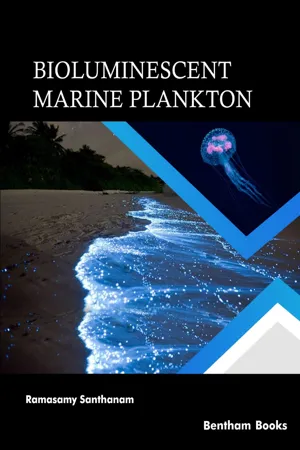
Bioluminescence, the "cold living light" or the "cold fire of the sea, " is extremely common in all oceans at all depths. However, this phenomenon is nearly absent in freshwater, with the exception of a freshwater limpet. More than 75% of deep-sea creatures have been reported to produce their own light. The luminescent marine plankton such as dinoflagellate, radiolarians, jellyfish, comb jellies, annelids, copepods, ostracods, mysids, amphipods, euphausiids, and tunicates form an important component in the marine food chain. Research on luminescent marine plankton is gaining momentum owing to its importance in life science research and medicine. The glowing Green Fluorescent Protein (GFP) extracted from the North Pacific jellyfish, Aqueorea victoria (for which the Japanese biologist, Osamu Shimonmura won the Nobel Prize in Chemistry in 2008) has helped shed light on key processes such as the spread of cancer, the development of brain cells, the growth of bacteria, damage to cells by Alzheimer's disease, and the development of insulin-producing cells in the pancreas. Therefore, it is difficult to underscore the importance of bioluminescence and the organisms associated with this phenomenon. Bioluminescent Marine Plankton is a unique reference that attempts to provide answers to questions about bioluminescence. The first of its kind, this book attempts to answer questions on the subject with a focus on planktonic organisms. 12 chapters provide information about the chemistry of bioluminescence, types of bioluminescent displays, distribution of bioluminescence among marine plankton, ecological functions and utility of planktonic bioluminescence. Chapters are dedicated to the biology and ecology of specific groups of plankton that span about 200 luminescent marine species. The detailed book is an essential compendium on marine plankton for a broad range of readers who want to learn about bioluminescent plankton. A list of detailed references is also provided for the benefit of teachers, students, researchers and enthusiasts interested in marine biology, aquaculture, and environmental sciences.
- English
- ePUB (mobile friendly)
- Available on iOS & Android
eBook - ePub
Bioluminescent Marine Plankton
About this book
Information
Table of contents
- Welcome
- Table of Content
- Title
- BENTHAM SCIENCE PUBLISHERS LTD.
- PREFACE
- Introduction
- Chemical Mechanism of Bioluminescence
- Bioluminescent Marine Dinoflagellates
- Bioluminescent Marine Radiolarians
- Bioluminescent Marine Cnidarians
- Bioluminescent Ctenophores
- Bioluminescent Planktonic Marine Annelids
- Bioluminescent Chaetognaths
- Bioluminescent Marine Crustaceans
- Bioluminescent Marine Mollusc
- Bioluminescent Tunicates
- Marine Bioluminescence and Biotechnology
- REFERENCES
Trusted by 375,005 students
Access to over 1.5 million titles for a fair monthly price.
Study more efficiently using our study tools.
Frequently asked questions
Yes, you can cancel anytime from the Subscription tab in your account settings on the Perlego website. Your subscription will stay active until the end of your current billing period. Learn how to cancel your subscription
No, books cannot be downloaded as external files, such as PDFs, for use outside of Perlego. However, you can download books within the Perlego app for offline reading on mobile or tablet. Learn how to download books offline
Perlego offers two plans: Essential and Complete
- Essential is ideal for learners and professionals who enjoy exploring a wide range of subjects. Access the Essential Library with 800,000+ trusted titles and best-sellers across business, personal growth, and the humanities. Includes unlimited reading time and Standard Read Aloud voice.
- Complete: Perfect for advanced learners and researchers needing full, unrestricted access. Unlock 1.5M+ books across hundreds of subjects, including academic and specialized titles. The Complete Plan also includes advanced features like Premium Read Aloud and Research Assistant.
We are an online textbook subscription service, where you can get access to an entire online library for less than the price of a single book per month. With over 1.5 million books across 990+ topics, we’ve got you covered! Learn about our mission
Look out for the read-aloud symbol on your next book to see if you can listen to it. The read-aloud tool reads text aloud for you, highlighting the text as it is being read. You can pause it, speed it up and slow it down. Learn more about Read Aloud
Yes! You can use the Perlego app on both iOS and Android devices to read anytime, anywhere — even offline. Perfect for commutes or when you’re on the go.
Please note we cannot support devices running on iOS 13 and Android 7 or earlier. Learn more about using the app
Please note we cannot support devices running on iOS 13 and Android 7 or earlier. Learn more about using the app
Yes, you can access Bioluminescent Marine Plankton by Ramasamy Santhanam in PDF and/or ePUB format, as well as other popular books in Biological Sciences & Marine Biology. We have over 1.5 million books available in our catalogue for you to explore.