Global Byzantium is, in part, a recasting and expansion of the old 'Byzantium and its neighbours' theme with, however, a methodological twist away from the resolutely political and toward the cultural and economic. A second thing that Global Byzantium – as a concept – explicitly endorses is comparative methodology. Global Byzantium needs also to address three further issues: cultural capital, the importance of the local, and the empire's strategic geographical location. Cultural capital: in past decades it was fashionable to define Byzantium as culturally superior to western Christian Europe, and Byzantine influence was a key concept, especially in art historical circles. This concept has been increasingly criticised, and what we now see emerging is a comparative methodology that relies on the concept of 'competitive sharing', not blind copying but rather competitive appropriation. The importance of the local is equally critical. We need to talk more about what the Byzantines saw when they 'looked out', and what others saw in Byzantium when they 'looked in' and to think about how that impacted on our, very post-modern, concepts of globalism. Finally, we need to think about the empire's strategic geographical position: between the fourth and the thirteenth centuries, if anyone was travelling internationally, they had to travel across (or along the coasts of) the Byzantine Empire. Byzantium was thus a crucial intermediary, for good or for ill, between Europe, Africa, and Asia – effectively, the glue that held the Christian world together, and it was also a critical transit point between the various Islamic polities and the Christian world.
eBook - ePub
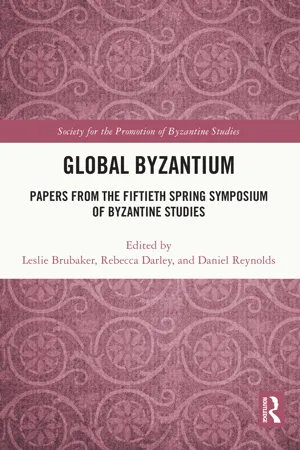
Global Byzantium
Papers from the Fiftieth Spring Symposium of Byzantine Studies
- 424 pages
- English
- ePUB (mobile friendly)
- Available on iOS & Android
eBook - ePub
Global Byzantium
Papers from the Fiftieth Spring Symposium of Byzantine Studies
Table of contents
- Cover Page
- Half Title page
- Series Page
- Title Page
- Copyright Page
- Contents
- List of Figures
- List of Tables
- List of Contributors
- Preface
- List of Abbreviations
- Acknowledgements
- Introduction: The Future of Global Byzantium
- 1 Seen from across the Sea: India in the Byzantine Worldview
- 2 Byzantium beyond Byzantium: What about Greek(s) in Eighth-Century Italy?1
- 3 Silk in the Byzantine World: Technology and Transmission
- 4 Composing World History at the Margins of Empire: Armenian and Byzantine Traditions in Comparative Perspective
- 5 Global Byzantium: Whirlwind Romance or Fundamental Paradigm Shift?
- 6 Global or Local Art?: The Mosaic Panels of Justinian and Theodora in S Vitale, Ravenna1
- 7 Movement and Mobility: Cotton and the Visibility of Trade Networks across the Saharan Desert
- 8 Maniera Greca and Renaissance Europe: More than Meets the Eye
- 9 Magical Signs in Christian Byzantium, Judaism, and Islam: A Global Language
- 10 How Global Was the Mediterranean in the Early Middle Ages?: A View from the Western Edge
- 11 Hegemony, Counterpower, and Global History: Medieval New Rome and Caucasia in a Critical Perspective
- 12 What Is ‘Byzantine’?: Gender, Ethnicity, and the Construction of Identities on Byzantium’s Literary Frontiers
- 13 The Helladic Paradigm in a Global Perspective
- 14 Secluded Place or Global Magnet?: The Monastery of Saint Catherine in the Sinai and its Manuscript Collection
- 15 Early Byzantine Art in China: A Test Case for Global Byzantium
- 16 Centre or Periphery?: Constantinople and the Eurasian Trading System at the End of Antiquity
- 17 Transferring Skills and Techniques across the Mediterranean: Some Preliminary Remarks on Stucco in Italy and Byzantium
- 18 Import, Export: The Global Impact of Byzantine Marriage Alliances during the Tenth Century
- 19 Conclusion: Post-Colonial Reflections and the Challenge of Global Byzantium
- Index
Trusted by 375,005 students
Access to over 1.5 million titles for a fair monthly price.
Study more efficiently using our study tools.
Frequently asked questions
Yes, you can cancel anytime from the Subscription tab in your account settings on the Perlego website. Your subscription will stay active until the end of your current billing period. Learn how to cancel your subscription
No, books cannot be downloaded as external files, such as PDFs, for use outside of Perlego. However, you can download books within the Perlego app for offline reading on mobile or tablet. Learn how to download books offline
Perlego offers two plans: Essential and Complete
- Essential is ideal for learners and professionals who enjoy exploring a wide range of subjects. Access the Essential Library with 800,000+ trusted titles and best-sellers across business, personal growth, and the humanities. Includes unlimited reading time and Standard Read Aloud voice.
- Complete: Perfect for advanced learners and researchers needing full, unrestricted access. Unlock 1.5M+ books across hundreds of subjects, including academic and specialized titles. The Complete Plan also includes advanced features like Premium Read Aloud and Research Assistant.
We are an online textbook subscription service, where you can get access to an entire online library for less than the price of a single book per month. With over 1.5 million books across 990+ topics, we’ve got you covered! Learn about our mission
Look out for the read-aloud symbol on your next book to see if you can listen to it. The read-aloud tool reads text aloud for you, highlighting the text as it is being read. You can pause it, speed it up and slow it down. Learn more about Read Aloud
Yes! You can use the Perlego app on both iOS and Android devices to read anytime, anywhere — even offline. Perfect for commutes or when you’re on the go.
Please note we cannot support devices running on iOS 13 and Android 7 or earlier. Learn more about using the app
Please note we cannot support devices running on iOS 13 and Android 7 or earlier. Learn more about using the app
Yes, you can access Global Byzantium by Leslie Brubaker, Rebecca Darley, Daniel Reynolds, Leslie Brubaker,Rebecca Darley,Daniel Reynolds in PDF and/or ePUB format, as well as other popular books in History & World History. We have over 1.5 million books available in our catalogue for you to explore.