The comparison of early Italy's and Japan's colonialism is without precedence. The majority of studies on Italian and Japanese expansion refer to the 1930–1940s period (fascist/totalitarian era) when Japan annexed Manchuria (1931) and Italy Ethiopia (1936). The first formative and crucial steps that paved the way for this expansion have been neglected.
This analysis covers a range of social, political and economic parameters illuminating the diversity but also the common ground of the nature and aspirations of Japan's and Italy's early colonial systems. The two states alongside the Great Powers of the era expanded in the name of humanism and civilization but in reality in a way typically imperialistic, they sought territorial compensations, financial privileges and prestige. A parallel and deeper understanding of the nineteenth century socio-cultural-psychological parameters, such as tradition, mentality, and religion that shaped and explain the later ideological framework of Rome's and T?ky?'s expansionist disposition, has never been attempted before. This monograph offers a detailed examination of the phenomenon of colonialism by examining the issue from two different angles. The study contributes to the understanding of Italy's and Japan's early imperial expansion. In addition, it traces the origins of these states' similar and common historical evolution in late nineteenth and the first half of the twentieth century.
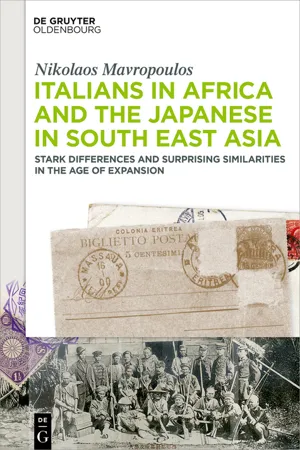
eBook - ePub
Italians in Africa and the Japanese in South East Asia
Stark Differences and Surprising Similarities in the Age of Expansion
- 432 pages
- English
- ePUB (mobile friendly)
- Available on iOS & Android
eBook - ePub
Italians in Africa and the Japanese in South East Asia
Stark Differences and Surprising Similarities in the Age of Expansion
About this book
Information
Subtopic
19th Century HistoryIndex
HistoryTable of contents
- Title Page
- Copyright
- Contents
- Introduction
- Part 1 Early Italian Colonialism
- Part 2 Early Japanese Colonialism
- Conclusions
- Bibliography
- Person Index
Trusted by 375,005 students
Access to over 1.5 million titles for a fair monthly price.
Study more efficiently using our study tools.
Frequently asked questions
Yes, you can cancel anytime from the Subscription tab in your account settings on the Perlego website. Your subscription will stay active until the end of your current billing period. Learn how to cancel your subscription
No, books cannot be downloaded as external files, such as PDFs, for use outside of Perlego. However, you can download books within the Perlego app for offline reading on mobile or tablet. Learn how to download books offline
Perlego offers two plans: Essential and Complete
- Essential is ideal for learners and professionals who enjoy exploring a wide range of subjects. Access the Essential Library with 800,000+ trusted titles and best-sellers across business, personal growth, and the humanities. Includes unlimited reading time and Standard Read Aloud voice.
- Complete: Perfect for advanced learners and researchers needing full, unrestricted access. Unlock 1.5M+ books across hundreds of subjects, including academic and specialized titles. The Complete Plan also includes advanced features like Premium Read Aloud and Research Assistant.
We are an online textbook subscription service, where you can get access to an entire online library for less than the price of a single book per month. With over 1.5 million books across 990+ topics, we’ve got you covered! Learn about our mission
Look out for the read-aloud symbol on your next book to see if you can listen to it. The read-aloud tool reads text aloud for you, highlighting the text as it is being read. You can pause it, speed it up and slow it down. Learn more about Read Aloud
Yes! You can use the Perlego app on both iOS and Android devices to read anytime, anywhere — even offline. Perfect for commutes or when you’re on the go.
Please note we cannot support devices running on iOS 13 and Android 7 or earlier. Learn more about using the app
Please note we cannot support devices running on iOS 13 and Android 7 or earlier. Learn more about using the app
Yes, you can access Italians in Africa and the Japanese in South East Asia by Nikolaos Mavropoulos in PDF and/or ePUB format, as well as other popular books in History & 19th Century History. We have over 1.5 million books available in our catalogue for you to explore.