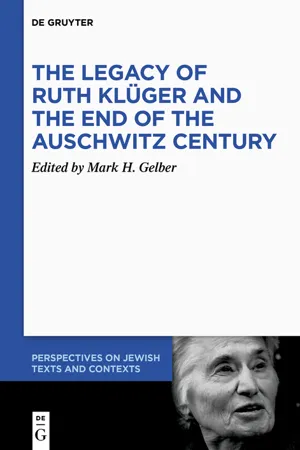
Ruth Klüger (1931 – 2020) passed away on October 5, 2020 in the U.S. Born in Vienna and deported to Theresienstadt, she survived Auschwitz and the Shoah together with her mother. After living in Germany for a short time after the War, she immigrated to New York. She was educated in the U.S. and received degrees in English literature as well as her Ph.D. in German literature at the University of California, Berkeley. She taught at several American universities. She has numerous scholarly publications to her credit, mostly in the fields of German and Austrian literary history. She is also recognized as a poet in her own right, an essayist, and a feminist critic. She returned to Europe, where she was a guest professor in Göttingen and Vienna. Her memoir, entitled weiter leben (1992), which she translated and revised in an English parallel-text as Still Alive, was a major bestseller and highly regarded autobiographical account of a Holocaust survivor. It was subsequently translated into more than a dozen languages. It has also generated a vigorous critical discussion in its own right. Ruth Klüger received numerous prestigious literary prizes and other distinctions.
The present volume, The Legacy of Ruth Klüger and the End of the Auschwitz Century, aims to honor her memory by assessing critically her writings and career. Taking her biography and writings as points of departure, the volume includes contributions in fields and from perspectives which her writings helped to bring into focus acutely. In the table of contents are listed the following contributions: Sander L. Gilman, "Poetry and Naming in Ruth Klüger's Works and Life"; Heinrich Detering, "'Spannung': Remarks on a Stylistic Principle in Ruth Klüger's Writing"; Stephan Braese, "Speaking with Germans. Ruth Klüger and the 'Restitution of Speech between Germans and Jews'"; Irène Heidelberger-Leonard, "Writing Auschwitz: Jean Améry, Imre Kertész, and Ruth Klüger"; Ulrike Offenberg, "Ruth Klüger and the Jewish Tradition on Women Saying Kaddish; Mark H. Gelber, "Ruth Klüger, Judaism, and Zionism: An American Perspective"; Monica Tempian, "Children's Voices in the Poetry of the Shoah"; Daniel Reynolds, "Ruth Klüger and the Problem of Holocaust Tourism"; Vera Schwarcz, "A China Angle on Memory and Ghosts in the Poetry of Ruth Klüger."