Between the 1880s and the 1940s, opportunities for southern white women writers increased dramatically, bolstered by readers' demands for southern stories in northern periodicals. Confined by magazine requirements and social expectations, writers often relied on regional settings and tropes to attract publishers and readers before publishing work in a collection. Selecting and ordering magazine stories for these collections was not arbitrary or dictated by editors, despite a male-dominated publishing industry. Instead, it allowed writers to privilege stories, or to contextualize a story by its proximity to other tales, as a form of social commentary. For Kate Chopin, Ellen Glasgow, Marjorie Kinnan Rawlings, and Katherine Anne Porter—the authors featured in this book—publishing a volume of stories enabled them to construct a narrative framework of their own.
Arranging Stories: Framing Social Commentary in Short Story Collections by Southern Women Writers is as much about how stories are constructed as how they are told. The book examines correspondence, manuscripts, periodicals, and first editions of collections. Each collection's textual history serves as a case study for changes in the periodical marketplace and demonstrates how writers negotiated this marketplace to publish stories and garner readership. The book also includes four tables, featuring collected stories' arrangements and publication histories, and twenty-five illustrations, featuring periodical publications, unpublished letters, and manuscript fragments obtained from nine on-site and digital archives. Short story collections guide readers through a spatial experience, in which both individual stories and the ordering of those stories become a framework for interpreting meaning. Arranging Stories invites readings that complicate how we engage collected works.
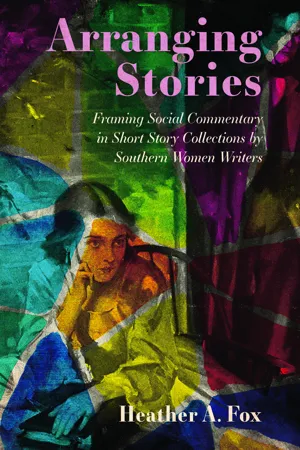
eBook - ePub
Arranging Stories
Framing Social Commentary in Short Story Collections by Southern Women Writers
- 206 pages
- English
- ePUB (mobile friendly)
- Available on iOS & Android
eBook - ePub
Arranging Stories
Framing Social Commentary in Short Story Collections by Southern Women Writers
About this book
Information
Table of contents
- Cover Page
- Title Page
- Copyright
- Dedication
- Contents
- Acknowledgments
- Introduction: Arranging Stories as a Frame for Social Commentary
- 1 Mapping Spatial Consciousness in Kate Chopin’s Bayou Folk (1894)
- 2 Advocating for Social Justice in Ellen Glasgow’s The Shadowy Third and Other Stories (1923)
- 3 Preserving the Hammock in Marjorie Kinnan Rawlings’s When the Whippoorwill (1940)
- 4 Reconstructing Memory in Katherine Anne Porter’s The Old Order Stories (1944, 1955, 1965)
- Epilogue: Reading Arrangement
- Notes
- Bibliography
- Index
- About the Author
Trusted by 375,005 students
Access to over 1.5 million titles for a fair monthly price.
Study more efficiently using our study tools.
Frequently asked questions
Yes, you can cancel anytime from the Subscription tab in your account settings on the Perlego website. Your subscription will stay active until the end of your current billing period. Learn how to cancel your subscription
No, books cannot be downloaded as external files, such as PDFs, for use outside of Perlego. However, you can download books within the Perlego app for offline reading on mobile or tablet. Learn how to download books offline
Perlego offers two plans: Essential and Complete
- Essential is ideal for learners and professionals who enjoy exploring a wide range of subjects. Access the Essential Library with 800,000+ trusted titles and best-sellers across business, personal growth, and the humanities. Includes unlimited reading time and Standard Read Aloud voice.
- Complete: Perfect for advanced learners and researchers needing full, unrestricted access. Unlock 1.5M+ books across hundreds of subjects, including academic and specialized titles. The Complete Plan also includes advanced features like Premium Read Aloud and Research Assistant.
We are an online textbook subscription service, where you can get access to an entire online library for less than the price of a single book per month. With over 1.5 million books across 990+ topics, we’ve got you covered! Learn about our mission
Look out for the read-aloud symbol on your next book to see if you can listen to it. The read-aloud tool reads text aloud for you, highlighting the text as it is being read. You can pause it, speed it up and slow it down. Learn more about Read Aloud
Yes! You can use the Perlego app on both iOS and Android devices to read anytime, anywhere — even offline. Perfect for commutes or when you’re on the go.
Please note we cannot support devices running on iOS 13 and Android 7 or earlier. Learn more about using the app
Please note we cannot support devices running on iOS 13 and Android 7 or earlier. Learn more about using the app
Yes, you can access Arranging Stories by Heather A. Fox in PDF and/or ePUB format, as well as other popular books in Literature & Publishing. We have over 1.5 million books available in our catalogue for you to explore.