“Whatever Principles are imbibed at College will run thro' a Man's whole future Conduct.”—--William Livingston, signer of the Constitution
Schools for Statesmen explores the fifty-five individual Framers of the Constitution in close detail and argues that their different educations help explain their divergent positions at the 1787 Constitutional Convention. Those educations ranged from outlawed Irish “hedge schools” to England’s venerable Inns of Court, from the grammar schools of New England to ambitious new academies springing up on the Carolina frontier. The more traditional schools that focused on Greek and Latin classics (Oxford, Harvard, Yale, William and Mary) were deeply conservative institutions resistant to change. But the Scottish colleges and the newer American schools (Princeton, Philadelphia, King’s College) introduced students to a Scottish Enlightenment curriculum that fostered more radical, forward-thinking leaders. Half of the Framers had no college education and were often self-taught or had private tutors; most were quiet at the convention, although a few stubbornly opposed the new ideas they were hearing. Nearly all the delegates who took the lead at the convention had been educated at the newer, innovative colleges, but of the seven who rejected the new Constitution, three had gone to the older traditional schools, while three others had not gone to college at all.
Schools for Statesmen is an unprecedented analysis of the sharply divergent educations of the Framers of the Constitution. It reveals the ways in which the Constitutional Convention, rather than being a counterrevolution by conservative elites, was dominated by forward-thinking innovators who had benefited from the educational revolution beginning in the mid-eighteenth century.
Andrew Browning offers a new and persuasive explanation of key disagreements among the Framers and the process by which they were able to break through the impasse that threatened the convention; he provides a fresh understanding of the importance of education in what has been called the “Critical Period” of US history.
Schools for Statesmen takes a deep dive into the diverse educational world of the eighteenth century and sheds new light on the origins of the US Constitution.
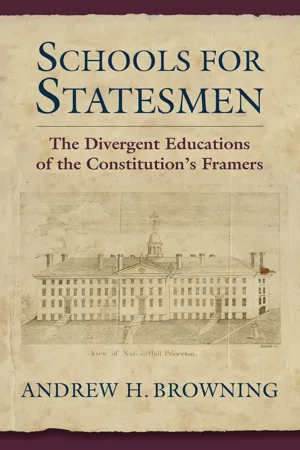
eBook - ePub
Schools for Statesmen
The Divergent Educations of the Constitution's Framers
- 368 pages
- English
- ePUB (mobile friendly)
- Available on iOS & Android
eBook - ePub
About this book
Information
Publisher
University Press of KansasYear
2022Print ISBN
9780700633098
9780700633098
eBook ISBN
9780700633104
Topic
HistoireSubtopic
Enseignement de l'HistoireTable of contents
- Front Cover
- Half Title
- Title Page
- Copyright Page
- Dedication
- Table of Contents
- Delegates to the 1787 Federal Convention: Age and Education
- A Note on Names
- Introduction
- Part I
- Part II
- Part III
- Conclusion
- Notes
- Bibliographic Essay
- Index
- Back Cover
Trusted by 375,005 students
Access to over 1.5 million titles for a fair monthly price.
Study more efficiently using our study tools.
Frequently asked questions
Yes, you can cancel anytime from the Subscription tab in your account settings on the Perlego website. Your subscription will stay active until the end of your current billing period. Learn how to cancel your subscription
No, books cannot be downloaded as external files, such as PDFs, for use outside of Perlego. However, you can download books within the Perlego app for offline reading on mobile or tablet. Learn how to download books offline
Perlego offers two plans: Essential and Complete
- Essential is ideal for learners and professionals who enjoy exploring a wide range of subjects. Access the Essential Library with 800,000+ trusted titles and best-sellers across business, personal growth, and the humanities. Includes unlimited reading time and Standard Read Aloud voice.
- Complete: Perfect for advanced learners and researchers needing full, unrestricted access. Unlock 1.5M+ books across hundreds of subjects, including academic and specialized titles. The Complete Plan also includes advanced features like Premium Read Aloud and Research Assistant.
We are an online textbook subscription service, where you can get access to an entire online library for less than the price of a single book per month. With over 1.5 million books across 990+ topics, we’ve got you covered! Learn about our mission
Look out for the read-aloud symbol on your next book to see if you can listen to it. The read-aloud tool reads text aloud for you, highlighting the text as it is being read. You can pause it, speed it up and slow it down. Learn more about Read Aloud
Yes! You can use the Perlego app on both iOS and Android devices to read anytime, anywhere — even offline. Perfect for commutes or when you’re on the go.
Please note we cannot support devices running on iOS 13 and Android 7 or earlier. Learn more about using the app
Please note we cannot support devices running on iOS 13 and Android 7 or earlier. Learn more about using the app
Yes, you can access Schools for Statesmen by Andrew H. Browning in PDF and/or ePUB format, as well as other popular books in Histoire & Enseignement de l'Histoire. We have over 1.5 million books available in our catalogue for you to explore.