eBook - ePub
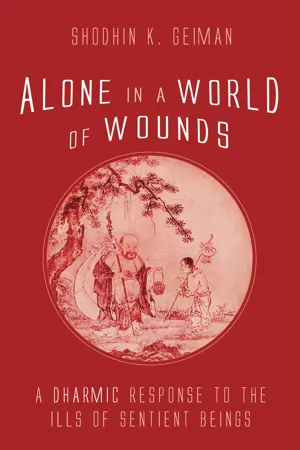
Alone in a World of Wounds
A Dharmic Response to the Ills of Sentient Beings
- 286 pages
- English
- ePUB (mobile friendly)
- Available on iOS & Android
eBook - ePub
About this book
When Buddhism came to the West in the 1960s, many were eager to adapt it straightaway to the prevailing social and intellectual currents of its new home. One of those adaptations was the creation of a "socially engaged" Buddhism that could stand alongside similar developments in Christian and Jewish thought. It seemed like a good idea at the time.
Beginning with what the tradition calls the path of "the holy life," a life free of every attachment to self and the delusions to which it gives rise, Geiman draws attention to the unique contribution the Dharma makes to one's understanding of the world, one's place within it, and the nature of wise and compassionate action in the face of human hardship. Along the way, he shows the limits of using the teaching of the Buddha and the Dharma Ancestors as support for social and political agendas of any kind. What emerges is a description of a noble life free of pretense and guile, which fearlessly and unshakably bears witness to the truth of our conditioned nature in the midst of human hardship--a life best described as standing alone in a world of wounds.
Information
Topic
Theology & ReligionSubtopic
Eastern PhilosophyTable of contents
- Title Page
- Introduction
- Part I: Going Alone
- Part II: Alone in the World
- Part III: Upāya Born of Emptiness
- Conclusion
- Postscript
- Bibliography
Trusted by 375,005 students
Access to over 1.5 million titles for a fair monthly price.
Study more efficiently using our study tools.
Frequently asked questions
Yes, you can cancel anytime from the Subscription tab in your account settings on the Perlego website. Your subscription will stay active until the end of your current billing period. Learn how to cancel your subscription
No, books cannot be downloaded as external files, such as PDFs, for use outside of Perlego. However, you can download books within the Perlego app for offline reading on mobile or tablet. Learn how to download books offline
Perlego offers two plans: Essential and Complete
- Essential is ideal for learners and professionals who enjoy exploring a wide range of subjects. Access the Essential Library with 800,000+ trusted titles and best-sellers across business, personal growth, and the humanities. Includes unlimited reading time and Standard Read Aloud voice.
- Complete: Perfect for advanced learners and researchers needing full, unrestricted access. Unlock 1.5M+ books across hundreds of subjects, including academic and specialized titles. The Complete Plan also includes advanced features like Premium Read Aloud and Research Assistant.
We are an online textbook subscription service, where you can get access to an entire online library for less than the price of a single book per month. With over 1.5 million books across 990+ topics, we’ve got you covered! Learn about our mission
Look out for the read-aloud symbol on your next book to see if you can listen to it. The read-aloud tool reads text aloud for you, highlighting the text as it is being read. You can pause it, speed it up and slow it down. Learn more about Read Aloud
Yes! You can use the Perlego app on both iOS and Android devices to read anytime, anywhere — even offline. Perfect for commutes or when you’re on the go.
Please note we cannot support devices running on iOS 13 and Android 7 or earlier. Learn more about using the app
Please note we cannot support devices running on iOS 13 and Android 7 or earlier. Learn more about using the app
Yes, you can access Alone in a World of Wounds by Shodhin K. Geiman in PDF and/or ePUB format, as well as other popular books in Theology & Religion & Eastern Philosophy. We have over 1.5 million books available in our catalogue for you to explore.