As a pioneering volume to consider the impact of exile on historical scholarship in the twentieth century in a systematic and global way, looking at Europe, North America, South America and Asia, Dynamics of Emigration asks about epistemic repercussions on the experience of exile and exiles. Analyzing both the impact that exile scholars had on their host societies and on the societies they had to leave, the volume investigates exiles' pathways to integration into new host societies and the many difficulties they face establishing themselves in new surroundings. Focusing on the age of extremes and the realms of exile from fascist and right-wing dictatorships as well as communist regimes, the contributions look at the reasons scholars have for going into exile while providing side-by-side examination of the support organizations and paths for success involved with living in exile.
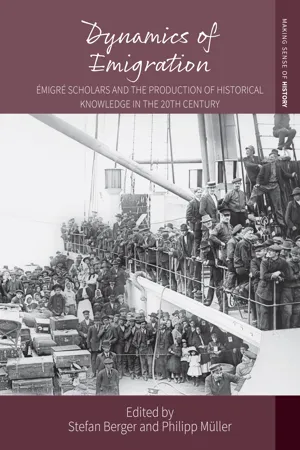
eBook - ePub
Dynamics of Emigration
Émigré Scholars and the Production of Historical Knowledge in the 20th Century
- 308 pages
- English
- ePUB (mobile friendly)
- Available on iOS & Android
eBook - ePub
Dynamics of Emigration
Émigré Scholars and the Production of Historical Knowledge in the 20th Century
About this book
Information
Table of contents
- Cover
- Title Page
- Copyright Page
- Contents
- Introduction. Dynamics of Émigré Scholarship in the Age of Extremes
- Chapter 1. ‘A Private Perch’: Cosmopolitanism, Nostalgia and Commitment in the Émigré Historian’s Persona
- Chapter 2. The Émigré Historian: A Scholarly Persona?
- Chapter 3. The Long Arm of the Dictator: Cross-Border Persecution of Exiled Historians
- Chapter 4. Nativism and the Spectre of Antisemitism in the Placement of German Refugee Scholars, 1933–1945
- Chapter 5. Defending Objectivity: Paul Oskar Kristeller and the Controversy over Historical Knowledge in the United States
- Chapter 6. Émigré Historians and the Postwar Transatlantic Dialogue
- Chapter 7. Between Integration and Institutional Self-Organisation: Polish Émigré Scholarship in the United States, 1939–1989
- Chapter 8. The Unlikely Careers of Laura Polanyi (1882–1959) as a Historian: The Intersections of Exile, Gender, Class and Age
- Chapter 9. ‘From Geistesgeschichte to Public History’: The Years of Emigration of the Hungarian Historian Béla Iványi-Grünwald, Jr.
- Chapter 10. Building New Networks: Russian Émigré Scholars in Yugoslavia
- Chapter 11. Networking in Santa Barbara, Writing History: Dimitrije Đorđević and the Comparative History of Balkan Nations
- Chapter 12. António Sérgio and José Ortega y Gasset: History, Theory and Experiences of Exile
- Chapter 13. Émigré Portuguese Historians in France, 1945–1974: New Methods of Thinking and Writing Portuguese History
- Conclusion. New Perspectives on Émigré Scholarship and What Remains to be Done
- Index
Trusted by 375,005 students
Access to over 1.5 million titles for a fair monthly price.
Study more efficiently using our study tools.
Frequently asked questions
Yes, you can cancel anytime from the Subscription tab in your account settings on the Perlego website. Your subscription will stay active until the end of your current billing period. Learn how to cancel your subscription
No, books cannot be downloaded as external files, such as PDFs, for use outside of Perlego. However, you can download books within the Perlego app for offline reading on mobile or tablet. Learn how to download books offline
Perlego offers two plans: Essential and Complete
- Essential is ideal for learners and professionals who enjoy exploring a wide range of subjects. Access the Essential Library with 800,000+ trusted titles and best-sellers across business, personal growth, and the humanities. Includes unlimited reading time and Standard Read Aloud voice.
- Complete: Perfect for advanced learners and researchers needing full, unrestricted access. Unlock 1.5M+ books across hundreds of subjects, including academic and specialized titles. The Complete Plan also includes advanced features like Premium Read Aloud and Research Assistant.
We are an online textbook subscription service, where you can get access to an entire online library for less than the price of a single book per month. With over 1.5 million books across 990+ topics, we’ve got you covered! Learn about our mission
Look out for the read-aloud symbol on your next book to see if you can listen to it. The read-aloud tool reads text aloud for you, highlighting the text as it is being read. You can pause it, speed it up and slow it down. Learn more about Read Aloud
Yes! You can use the Perlego app on both iOS and Android devices to read anytime, anywhere — even offline. Perfect for commutes or when you’re on the go.
Please note we cannot support devices running on iOS 13 and Android 7 or earlier. Learn more about using the app
Please note we cannot support devices running on iOS 13 and Android 7 or earlier. Learn more about using the app
Yes, you can access Dynamics of Emigration by Stefan Berger, Philipp Müller, Stefan Berger,Philipp Müller in PDF and/or ePUB format, as well as other popular books in History & 20th Century History. We have over 1.5 million books available in our catalogue for you to explore.