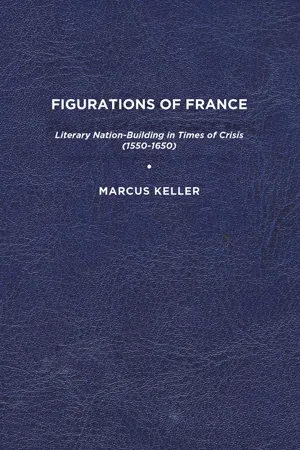
Figurations of France
eBook - ePub

Figurations of France

Literary Nation-Building in Times of Crisis (1550-1650)

  1. English
  2. ePUB (mobile friendly)
  3. Available on iOS & Android
eBook - ePub

Figurations of France

Literary Nation-Building in Times of Crisis (1550-1650)

About this book

In Figurations of France: Literary Nation-Building in Times of Crisis (1550-1650), Marcus Keller explores the often indirect and subtle ways in which key texts of early modern French literature, from Joachim Du Bellay's DĂ©fense et illustration de la langue française to Corneille's Le Cid, contribute to the fiction of France as a nation. Through his fresh take on these and other classics, he shows that they not only create the French as an imaginary community but also provide venues for an incisive critique of the political and cultural construct that underpins the modern nation-state.

Current theories of nationhood, in particular the concepts of the nation form and fictive ethnicity (Étienne Balibar), inform the close readings of Du Bellay's DĂ©fense, Ronsard's Discours, d'AubignĂ©'s Tragiques, Montaigne's Essays, Malherbe's odes, and Corneille's Le Cid and Horace. They reveal the imaginary power and unifying force of early modern figurations of France that come to bear in this heteregoneous corpus of French literature, with texts ranging from manifesto and epic poem to essay and tragedy. Situating each author and text in their particular historical context, the study suggests that the literary invention of France in the sixteenth and seventeenth centuries is as abundant as it is conceptually innovative: Du Bellay, for example, develops an idea of France by portraying the French language as a pruned and grafted tree while d'AubignĂ© proposes to think of the French as a nuclear but fatherless family. Blood functions as a highly charged metaphor of nationhood in all texts.

Opening up new perspectives on these canonical works, the focus on literary nation-building also puts them into unexpected and thought-provoking relationships to each other. Figurations of France deliberately crosses the fictive boundary between the sixteenth and the seventeenth centuries and argues that, in terms of imaginary nation-building, the contours that delineate the early modern period and separate it from what we call the modern era quickly begin to dissolve. Ultimately, the book makes the case for early modern literature as a creative and critical discourse, able to nourish and nuance our thinking about the nation as the postmodern nation-state is increasingly called into question by the economical, political, and cultural effects of globalization.

Published by University of Delaware Press. Distributed worldwide by Rutgers University Press.
 

Trusted by 375,005 students

Access to over 1.5 million titles for a fair monthly price.

Study more efficiently using our study tools.

Information

Year
2011
Print ISBN
9781644531365
9781644531358
eBook ISBN
9781644531372

Table of contents

  1. Acknowledgments
  2. INTRODUCTION The (Early) Modern Nation: Figuration, Creation, Critique
  3. CHAPTER ONE The Language-Plant in the Garden of France:Imitation and Nation in La Deffence etIllustration de la Langue Françoyse
  4. CHAPTER TWO Mother France and Her Dysfunctional Family: Religious and National Imagery in Ronsard’s Discours and Continuation and in d’Aubigné’s Tragiques
  5. CHAPTER THREE “A Violent and Treacherous Schoolmistress”: Custom and the Nationalization of the Individual in the Essais
  6. CHAPTER FOUR Faith in the Spirit of France: Mythology and the Myth of the Nation in Malherbe’s Odes
  7. CHAPTER FIVE Blood Transvaluations and the Limits of Patriotism: The Staging of Fictive Ethnicity in Le Cid and Horace
  8. CONCLUSION The Open Boundaries of Literary Nation-Building
  9. Notes
  10. Bibliography
  11. About the Author

Frequently asked questions

Yes, you can cancel anytime from the Subscription tab in your account settings on the Perlego website. Your subscription will stay active until the end of your current billing period. Learn how to cancel your subscription
No, books cannot be downloaded as external files, such as PDFs, for use outside of Perlego. However, you can download books within the Perlego app for offline reading on mobile or tablet. Learn how to download books offline
Perlego offers two plans: Essential and Complete
  • Essential is ideal for learners and professionals who enjoy exploring a wide range of subjects. Access the Essential Library with 800,000+ trusted titles and best-sellers across business, personal growth, and the humanities. Includes unlimited reading time and Standard Read Aloud voice.
  • Complete: Perfect for advanced learners and researchers needing full, unrestricted access. Unlock 1.5M+ books across hundreds of subjects, including academic and specialized titles. The Complete Plan also includes advanced features like Premium Read Aloud and Research Assistant.
Both plans are available with monthly, semester, or annual billing cycles.
We are an online textbook subscription service, where you can get access to an entire online library for less than the price of a single book per month. With over 1.5 million books across 990+ topics, we’ve got you covered! Learn about our mission
Look out for the read-aloud symbol on your next book to see if you can listen to it. The read-aloud tool reads text aloud for you, highlighting the text as it is being read. You can pause it, speed it up and slow it down. Learn more about Read Aloud
Yes! You can use the Perlego app on both iOS and Android devices to read anytime, anywhere — even offline. Perfect for commutes or when you’re on the go.
Please note we cannot support devices running on iOS 13 and Android 7 or earlier. Learn more about using the app
Yes, you can access Figurations of France by Marcus Keller in PDF and/or ePUB format, as well as other popular books in Literature & French History. We have over 1.5 million books available in our catalogue for you to explore.