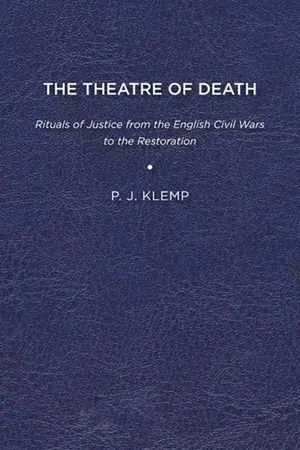
The Theatre of Death
eBook - ePub

The Theatre of Death

Rituals of Justice from the English Civil Wars to the Restoration

  1. English
  2. ePUB (mobile friendly)
  3. Available on iOS & Android
eBook - ePub

The Theatre of Death

Rituals of Justice from the English Civil Wars to the Restoration

About this book

This book discusses some rituals of justice—such as public executions, printed responses to the Archbishop of Canterbury's execution speech, and King Charles I's treason trial—in early modern England. Focusing on the ways in which genres shape these events' multiple voices, I analyze the rituals' genres and the diverse perspectives from which we must understand them.

The execution ritual, like such cultural forms as plays and films, is a collaborative production that can be understood only, and only incompletely, by being alert to the presence of its many participants and their contributions. Each of these participants brings a voice to the execution ritual, whether it is the judge and jury or the victim, executioner, sheriff and other authorities, spiritual counselors, printer, or spectators and readers. And each has at least one role to play. No matter how powerful some institutions and individuals may appear, none has a monopoly over authority and how the events take shape on and beyond the scaffold. The centerpiece of the mid-seventeenth-century's theatre of death was the condemned man's last dying utterance. This study focuses on the words and contexts of many of those final speeches, including King Charles I's (1649), Archbishop William Laud's (1645), and the Earl of Strafford's (1641), as well as those of less well known royalists and regicides. Where we situate ourselves to view, hear, and comprehend a public execution—through specific participants' eyes, ears, and minds or accounts—shapes our interpretation of the ritual. It is impossible to achieve a singular, carefully indoctrinated meaning of an event as complex as a state-sponsored public execution.

Along with the variety of voices and meanings, the nature and purpose of the rituals of justice maintain a significant amount of consistency in a number of eras and cultural contexts. Whether the focus is on the trial and execution of the Marian martyrs, English royalists in the 1640s and 1650s, or the Restoration's regicides, the events draw on a set of cultural expectations or conventions. Because rituals of justice are shaped by diverse voices and agendas, with the participants' scripts and counterscripts converging and colliding, they are dramatic moments conveying profound meanings.

Published by University of Delaware Press. Distributed worldwide by Rutgers University Press.
 

Information

Year
2016
Print ISBN
9781644530313
9781644530306
eBook ISBN
9781644530320

Table of contents

  1. Title Page
  2. List of Figures
  3. Preface
  4. Acknowledgments
  5. Introduction
  6. “I have been bred upon the Theater of death, and have learned that part”
  7. The Earl of Strafford’s Trial and Scaffold Speech
  8. The Earl of Strafford’s Trial and Scaffold Speech
  9. Archbishop William Laud in the Theatre of Execution
  10. Civil War Politics and the Texts of Archbishop William Laud’s Execution Sermon and Prayers
  11. Genre Criticism and the Animadversions upon Archbishop William Laud’s Execution Sermon and Prayers
  12. Self-Referential Defense Strategies in King Charles I’s Treason Trial
  13. The Earl of Strafford, Archbishop Laud, and King Charles I’s Deflation of Genre in His Speech Made upon the Scaffold
  14. “The Last Actors in This Bloody Tragedy”
  15. Afterword
  16. Works Cited
  17. Index
  18. About the Author

Trusted by 375,005 students

Access to over 1.5 million titles for a fair monthly price.

Study more efficiently using our study tools.

Frequently asked questions

Yes, you can cancel anytime from the Subscription tab in your account settings on the Perlego website. Your subscription will stay active until the end of your current billing period. Learn how to cancel your subscription
No, books cannot be downloaded as external files, such as PDFs, for use outside of Perlego. However, you can download books within the Perlego app for offline reading on mobile or tablet. Learn how to download books offline
Perlego offers two plans: Essential and Complete
  • Essential is ideal for learners and professionals who enjoy exploring a wide range of subjects. Access the Essential Library with 800,000+ trusted titles and best-sellers across business, personal growth, and the humanities. Includes unlimited reading time and Standard Read Aloud voice.
  • Complete: Perfect for advanced learners and researchers needing full, unrestricted access. Unlock 1.5M+ books across hundreds of subjects, including academic and specialized titles. The Complete Plan also includes advanced features like Premium Read Aloud and Research Assistant.
Both plans are available with monthly, semester, or annual billing cycles.
We are an online textbook subscription service, where you can get access to an entire online library for less than the price of a single book per month. With over 1.5 million books across 990+ topics, we’ve got you covered! Learn about our mission
Look out for the read-aloud symbol on your next book to see if you can listen to it. The read-aloud tool reads text aloud for you, highlighting the text as it is being read. You can pause it, speed it up and slow it down. Learn more about Read Aloud
Yes! You can use the Perlego app on both iOS and Android devices to read anytime, anywhere — even offline. Perfect for commutes or when you’re on the go.
Please note we cannot support devices running on iOS 13 and Android 7 or earlier. Learn more about using the app
Yes, you can access The Theatre of Death by P J Klemp in PDF and/or ePUB format, as well as other popular books in Literature & English Literary Criticism. We have over 1.5 million books available in our catalogue for you to explore.