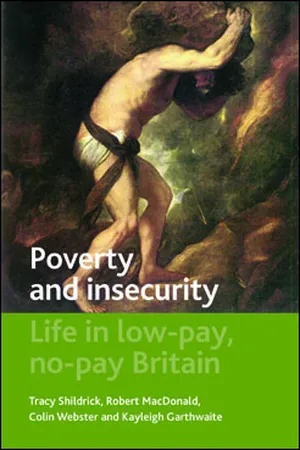
Winner of the British Academy Peter Townsend Prize for 2013 How do men and women get by in times and places where opportunities for standard employment have drastically reduced? Are we witnessing the growth of a new class, the 'Precariat', where people exist without predictability or security in their lives? What effects do flexible and insecure forms of work have on material and psychological well-being? This book is the first of its kind to examine the relationship between social exclusion, poverty and the labour market. It challenges long-standing and dominant myths about 'the workless' and 'the poor', by exploring close-up the lived realities of life in low-pay, no-pay Britain. Work may be 'the best route out of poverty' sometimes but for many people getting a job can be just a turn in the cycle of recurrent poverty – and of long-term churning between low-skilled 'poor work' and unemployment. Based on unique qualitative, life-history research with a 'hard-to-reach group' of younger and older people, men and women, the book shows how poverty and insecurity have now become the defining features of working life for many.
- 264 pages
- English
- PDF
- Available on iOS & Android
eBook - PDF
About this book
Information
Table of contents
- Contents
- List of figures and boxes
- Acknowledgements
- 1. Introduction
- 2. Poor work, welfare and poverty
- 3. Researching the low-pay, no-pay cycle and recurrent poverty
- 4. The low-pay, no-pay cycle: the perspectives and practices of employers and ‘welfare to work’ agencies
- 5. The low-pay, no-pay cycle: its pattern and people’s commitment to work
- 6. Searching for jobs: qualifications, support for the workless and the good and bad of informal social networks
- 7. Poor work: insecurity and churning in deindustrialised labour markets
- 8. ‘The ties that bind’: ill health and caring and their impact on the low-pay, no-pay cycle
- 9. Poverty and social insecurity
- 10. Conclusions
- References
- Index
Trusted by 375,005 students
Access to over 1.5 million titles for a fair monthly price.
Study more efficiently using our study tools.
Frequently asked questions
Yes, you can cancel anytime from the Subscription tab in your account settings on the Perlego website. Your subscription will stay active until the end of your current billing period. Learn how to cancel your subscription
No, books cannot be downloaded as external files, such as PDFs, for use outside of Perlego. However, you can download books within the Perlego app for offline reading on mobile or tablet. Learn how to download books offline
Perlego offers two plans: Essential and Complete
- Essential is ideal for learners and professionals who enjoy exploring a wide range of subjects. Access the Essential Library with 800,000+ trusted titles and best-sellers across business, personal growth, and the humanities. Includes unlimited reading time and Standard Read Aloud voice.
- Complete: Perfect for advanced learners and researchers needing full, unrestricted access. Unlock 1.5M+ books across hundreds of subjects, including academic and specialized titles. The Complete Plan also includes advanced features like Premium Read Aloud and Research Assistant.
We are an online textbook subscription service, where you can get access to an entire online library for less than the price of a single book per month. With over 1.5 million books across 990+ topics, we’ve got you covered! Learn about our mission
Look out for the read-aloud symbol on your next book to see if you can listen to it. The read-aloud tool reads text aloud for you, highlighting the text as it is being read. You can pause it, speed it up and slow it down. Learn more about Read Aloud
Yes! You can use the Perlego app on both iOS and Android devices to read anytime, anywhere — even offline. Perfect for commutes or when you’re on the go.
Please note we cannot support devices running on iOS 13 and Android 7 or earlier. Learn more about using the app
Please note we cannot support devices running on iOS 13 and Android 7 or earlier. Learn more about using the app
Yes, you can access Poverty and Insecurity by Shildrick, Tracy,MacDonald, Robert in PDF and/or ePUB format, as well as other popular books in Politics & International Relations & Social Policy. We have over 1.5 million books available in our catalogue for you to explore.