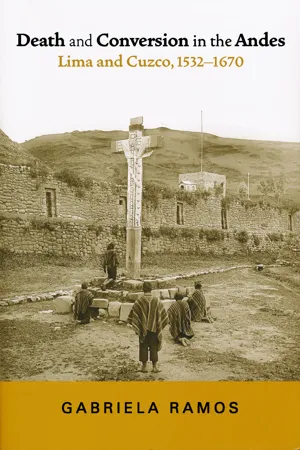
Death and Conversion in the Andes
eBook - PDF

Death and Conversion in the Andes

Lima and Cuzco, 1532-1670

  1. English
  2. PDF
  3. Available on iOS & Android
eBook - PDF

Death and Conversion in the Andes

Lima and Cuzco, 1532-1670

About this book

When the Spanish invaded the Inca empire in 1532, the cult of the ancestors was an essential feature of pre-Columbian religion throughout the Andes. The dead influenced politics, protected the living, symbolized the past, and legitimized claims over the land their descendants occupied, while the living honored the presence of the dead in numerous aspects of daily life. A central purpose of the Spanish missionary endeavor was to suppress the Andean cult of the ancestors and force the indigenous people to adopt their Catholic, legal, and cultural views concerning death. In her book, Gabriela Ramos reveals the extent to which Christianizing death was essential for the conversion of the indigenous population to Catholicism.

Ramos argues that understanding the relation between death and conversion in the Andes involves not only considering the obvious attempts to destroy the cult of the dead, but also investigating a range of policies and strategies whose application demanded continuous negotiation between Spaniards and Andeans. Drawing from historical, archaeological, and anthropological research and a wealth of original archival materials, especially the last wills and testaments of indigenous Andeans, Ramos looks at the Christianization of death as it affected the lives of inhabitants of two principal cities of the Peruvian viceroyalty: Lima, the new capital founded on the Pacific coast by the Spanish, and Cuzco, the old capital of the Incas in the Andean highlands. Her study of the wills in particular demonstrates the strategies that Andeans devised to submit to Spanish law and Christian doctrine, preserve bonds of kinship, and cement their place in colonial society.

Frequently asked questions

Yes, you can cancel anytime from the Subscription tab in your account settings on the Perlego website. Your subscription will stay active until the end of your current billing period. Learn how to cancel your subscription.
No, books cannot be downloaded as external files, such as PDFs, for use outside of Perlego. However, you can download books within the Perlego app for offline reading on mobile or tablet. Learn more here.
Perlego offers two plans: Essential and Complete
  • Essential is ideal for learners and professionals who enjoy exploring a wide range of subjects. Access the Essential Library with 800,000+ trusted titles and best-sellers across business, personal growth, and the humanities. Includes unlimited reading time and Standard Read Aloud voice.
  • Complete: Perfect for advanced learners and researchers needing full, unrestricted access. Unlock 1.4M+ books across hundreds of subjects, including academic and specialized titles. The Complete Plan also includes advanced features like Premium Read Aloud and Research Assistant.
Both plans are available with monthly, semester, or annual billing cycles.
We are an online textbook subscription service, where you can get access to an entire online library for less than the price of a single book per month. With over 1 million books across 1000+ topics, we’ve got you covered! Learn more here.
Look out for the read-aloud symbol on your next book to see if you can listen to it. The read-aloud tool reads text aloud for you, highlighting the text as it is being read. You can pause it, speed it up and slow it down. Learn more here.
Yes! You can use the Perlego app on both iOS or Android devices to read anytime, anywhere — even offline. Perfect for commutes or when you’re on the go.
Please note we cannot support devices running on iOS 13 and Android 7 or earlier. Learn more about using the app.
Yes, you can access Death and Conversion in the Andes by Gabriela Ramos in PDF and/or ePUB format, as well as other popular books in History & Latin American & Caribbean History. We have over one million books available in our catalogue for you to explore.

Table of contents

  1. Cover
  2. Half title
  3. Series page
  4. Title page
  5. Copyright
  6. Contents
  7. Maps
  8. Acknowledgments
  9. Introduction
  10. 1. Death in Pre-Hispanic Peru
  11. 2. Death during the Conquest
  12. 3. The Conquest of Death
  13. 4. Spaces and Institutions for the Missionary Project
  14. 5. Wills, Graves, and Funeral Rites
  15. 6. Ancestors, Successors, and Memory
  16. Conclusion
  17. Appendix A: Burial Sites, Confraternity Membership, and Funeral Rites
  18. Appendix B: Heirs and Executors
  19. Notes
  20. Bibliography
  21. Index