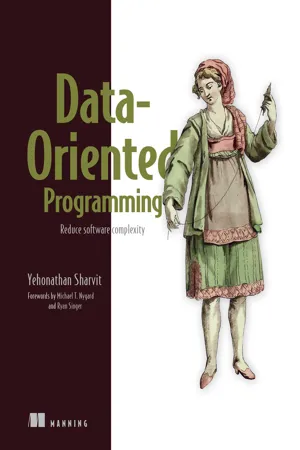
Eliminate the unavoidable complexity of object-oriented designs. The innovative data-oriented programming paradigm makes your systems less complex by making it simpler to access and manipulate data.
In Data-Oriented Programming you will learn how to:
Separate code from data
Represent data with generic data structures
Manipulate data with general-purpose functions
Manage state without mutating data
Control concurrency in highly scalable systems
Write data-oriented unit tests
Specify the shape of your data
Benefit from polymorphism without objects
Debug programs without a debugger
Data-Oriented Programming is a one-of-a-kind guide that introduces the data-oriented paradigm. This groundbreaking approach represents data with generic immutable data structures. It simplifies state management, eases concurrency, and does away with the common problems you’ll find in object-oriented code. The book presents powerful new ideas through conversations, code snippets, and diagrams that help you quickly grok what’s great about DOP. Best of all, the paradigm is language-agnostic—you’ll learn to write DOP code that can be implemented in JavaScript, Ruby, Python, Clojure, and also in traditional OO languages like Java or C#.
Forewords by Michael T. Nygard and Ryan Singer.
About the technology
Code that combines behavior and data, as is common in object-oriented designs, can introduce almost unmanageable complexity for state management. The Data-oriented programming (DOP) paradigm simplifies state management by holding application data in immutable generic data structures and then performing calculations using non-mutating general-purpose functions. Your applications are free of state-related bugs and your code is easier to understand and maintain.
About the book
Data-Oriented Programming teaches you to design software using the groundbreaking data-oriented paradigm. You’ll put DOP into action to design data models for business entities and implement a library management system that manages state without data mutation. The numerous diagrams, intuitive mind maps, and a unique conversational approach all help you get your head around these exciting new ideas. Every chapter has a lightbulb moment that will change the way you think about programming.
What's inside
Separate code from data
Represent data with generic data structures
Manage state without mutating data
Control concurrency in highly scalable systems
Write data-oriented unit tests
Specify the shape of your data
About the reader
For programmers who have experience with a high-level programming language like JavaScript, Java, Python, C#, Clojure, or Ruby.
About the author
Yehonathan Sharvit has over twenty years of experience as a software engineer. He blogs, speaks at conferences, and leads Data-Oriented Programming workshops around the world.
Table of Contents
PART 1 FLEXIBILITY
1 Complexity of object-oriented programming
2 Separation between code and data
3 Basic data manipulation
4 State management
5 Basic concurrency control
6 Unit tests
PART 2 SCALABILITY
7 Basic data validation
8 Advanced concurrency control
9 Persistent data structures
10 Database operations
11 Web services
PART 3 MAINTAINABILITY
12 Advanced data validation
13 Polymorphism
14 Advanced data manipulation
15 Debugging
- 424 pages
- English
- ePUB (mobile friendly)
- Available on iOS & Android
eBook - ePub
About this book
Information
Table of contents
- inside front cover
- Data-Oriented Programming
- Copyright
- dedication
- Brief contents
- contents
- front matter
- Part 1. Flexibility
- 1 Complexity of object-oriented programming
- 2 Separation between code and data
- 3 Basic data manipulation
- 4 State management
- 5 Basic concurrency control
- 6 Unit tests
- Part 2. Scalability
- 7 Basic data validation
- 8 Advanced concurrency control
- 9 Persistent data structures
- 10 Database operations
- 11 Web services
- Part 3. Maintainability
- 12 Advanced data validation
- 13 Polymorphism
- 14 Advanced data manipulation
- 15 Debugging
- Appendix A. Principles of data-oriented programming
- Appendix B. Generic data access in statically-typed languages
- Appendix C. Data-oriented programming: A link in the chain of programming paradigms
- Appendix D. Lodash reference
- index
- inside back cover
Trusted by 375,005 students
Access to over 1.5 million titles for a fair monthly price.
Study more efficiently using our study tools.
Frequently asked questions
Yes, you can cancel anytime from the Subscription tab in your account settings on the Perlego website. Your subscription will stay active until the end of your current billing period. Learn how to cancel your subscription
No, books cannot be downloaded as external files, such as PDFs, for use outside of Perlego. However, you can download books within the Perlego app for offline reading on mobile or tablet. Learn how to download books offline
Perlego offers two plans: Essential and Complete
- Essential is ideal for learners and professionals who enjoy exploring a wide range of subjects. Access the Essential Library with 800,000+ trusted titles and best-sellers across business, personal growth, and the humanities. Includes unlimited reading time and Standard Read Aloud voice.
- Complete: Perfect for advanced learners and researchers needing full, unrestricted access. Unlock 1.5M+ books across hundreds of subjects, including academic and specialized titles. The Complete Plan also includes advanced features like Premium Read Aloud and Research Assistant.
We are an online textbook subscription service, where you can get access to an entire online library for less than the price of a single book per month. With over 1.5 million books across 990+ topics, we’ve got you covered! Learn about our mission
Look out for the read-aloud symbol on your next book to see if you can listen to it. The read-aloud tool reads text aloud for you, highlighting the text as it is being read. You can pause it, speed it up and slow it down. Learn more about Read Aloud
Yes! You can use the Perlego app on both iOS and Android devices to read anytime, anywhere — even offline. Perfect for commutes or when you’re on the go.
Please note we cannot support devices running on iOS 13 and Android 7 or earlier. Learn more about using the app
Please note we cannot support devices running on iOS 13 and Android 7 or earlier. Learn more about using the app
Yes, you can access Data-Oriented Programming by Yehonathan Sharvit in PDF and/or ePUB format, as well as other popular books in Computer Science & Object Oriented Programming. We have over 1.5 million books available in our catalogue for you to explore.