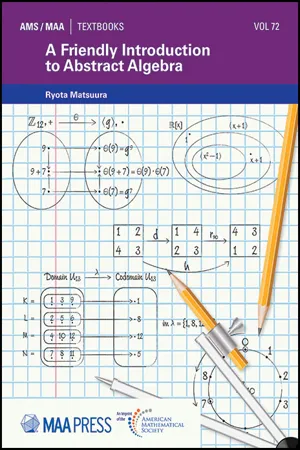
A Friendly Introduction to Abstract Algebra offers a new approach to laying a foundation for abstract mathematics. Prior experience with proofs is not assumed, and the book takes time to build proof-writing skills in ways that will serve students through a lifetime of learning and creating mathematics.The author's pedagogical philosophy is that when students abstract from a wide range of examples, they are better equipped to conjecture, formalize, and prove new ideas in abstract algebra. Thus, students thoroughly explore all concepts through illuminating examples before formal definitions are introduced. The instruction in proof writing is similarly grounded in student exploration and experience. Throughout the book, the author carefully explains where the ideas in a given proof come from, along with hints and tips on how students can derive those proofs on their own.Readers of this text are not just consumers of mathematical knowledge. Rather, they are learning mathematics by creating mathematics. The author's gentle, helpful writing voice makes this text a particularly appealing choice for instructors and students alike. The book's website has companion materials that support the active-learning approaches in the book, including in-class modules designed to facilitate student exploration.
- 404 pages
- English
- PDF
- Available on iOS & Android
eBook - PDF
A Friendly Introduction to Abstract Algebra
About this book
Information
Table of contents
- Cover
- Title page
- Copyright
- Contents
- Preface
- Unit I: Preliminaries
- Chapter 1. Introduction to Proofs
- Chapter 2. Sets and Subsets
- Chapter 3. Divisors
- Unit II: Examples of Groups
- Chapter 4. Modular Arithmetic
- Chapter 5. Symmetries
- Chapter 6. Permutations
- Chapter 7. Matrices
- Unit III: Introduction to Groups
- Chapter 8. Introduction to Groups
- Chapter 9. Groups of Small Size
- Chapter 10. Matrix Groups
- Chapter 11. Subgroups
- Chapter 12. Order of an Element
- Chapter 13. Cyclic Groups, Part I
- Chapter 14. Cyclic Groups, Part II
- Unit IV: Group Homomorphisms
- Chapter 15. Functions
- Chapter 16. Isomorphisms
- Chapter 17. Homomorphisms, Part I
- Chapter 18. Homomorphisms, Part II
- Unit V: Quotient Groups
- Chapter 19. Introduction to Cosets
- Chapter 20. Lagrange’s Theorem
- Chapter 21. Multiplying/Adding Cosets
- Chapter 22. Quotient Group Examples
- Chapter 23. Quotient Group Proofs
- Chapter 24. Normal Subgroups
- Chapter 25. First Isomorphism Theorem
- Unit VI: Introduction to Rings
- Chapter 26. Introduction to Rings
- Chapter 27. Integral Domains and Fields
- Chapter 28. Polynomial Rings, Part I
- Chapter 29. Polynomial Rings, Part II
- Chapter 30. Factoring Polynomials
- Unit VII: Quotient Rings
- Chapter 31. Ring Homomorphisms
- Chapter 32. Introduction to Quotient Rings
- Chapter 33. Quotient Ring Z ₇[𝑥]/⟨𝑥²-1⟩
- Chapter 34. Quotient Ring R [𝑥]/⟨𝑥²+1⟩
- Chapter 35. 𝐹[𝑥]/⟨𝑔(𝑥)⟩ Is/Isn’t a Field, Part I
- Chapter 36. Maximal Ideals
- Chapter 37. 𝐹[𝑥]/⟨𝑔(𝑥)⟩ Is/Isn’t a Field, Part II
- Appendix A. Proof of the GCD Theorem
- Appendix B. Composition Table for 𝐷₄
- Appendix C. Symbols and Notations
- Appendix D. Essential Theorems
- Index of Terms
- Back Cover
Trusted by 375,005 students
Access to over 1.5 million titles for a fair monthly price.
Study more efficiently using our study tools.
Frequently asked questions
Yes, you can cancel anytime from the Subscription tab in your account settings on the Perlego website. Your subscription will stay active until the end of your current billing period. Learn how to cancel your subscription
No, books cannot be downloaded as external files, such as PDFs, for use outside of Perlego. However, you can download books within the Perlego app for offline reading on mobile or tablet. Learn how to download books offline
Perlego offers two plans: Essential and Complete
- Essential is ideal for learners and professionals who enjoy exploring a wide range of subjects. Access the Essential Library with 800,000+ trusted titles and best-sellers across business, personal growth, and the humanities. Includes unlimited reading time and Standard Read Aloud voice.
- Complete: Perfect for advanced learners and researchers needing full, unrestricted access. Unlock 1.5M+ books across hundreds of subjects, including academic and specialized titles. The Complete Plan also includes advanced features like Premium Read Aloud and Research Assistant.
We are an online textbook subscription service, where you can get access to an entire online library for less than the price of a single book per month. With over 1.5 million books across 990+ topics, we’ve got you covered! Learn about our mission
Look out for the read-aloud symbol on your next book to see if you can listen to it. The read-aloud tool reads text aloud for you, highlighting the text as it is being read. You can pause it, speed it up and slow it down. Learn more about Read Aloud
Yes! You can use the Perlego app on both iOS and Android devices to read anytime, anywhere — even offline. Perfect for commutes or when you’re on the go.
Please note we cannot support devices running on iOS 13 and Android 7 or earlier. Learn more about using the app
Please note we cannot support devices running on iOS 13 and Android 7 or earlier. Learn more about using the app
Yes, you can access A Friendly Introduction to Abstract Algebra by Ryota Matsuura in PDF and/or ePUB format, as well as other popular books in Mathematics & Mathematics General. We have over 1.5 million books available in our catalogue for you to explore.