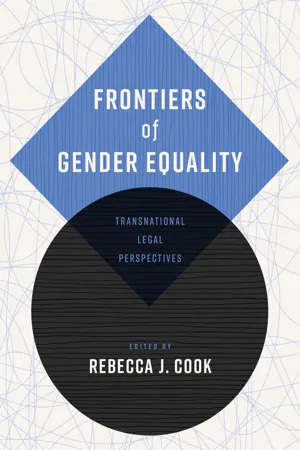
In Frontiers of Gender Equality, editor Rebecca Cook enlarges the chorus of voices to introduce new and different discourses about the wrongs of gender discrimination and to explain the multiple dimensions of gender equality. This volume demonstrates that the wrongs of discrimination can best be understood from the perspective of the discriminated, and that gender discrimination persists and grows in new and different contexts, widening the gap between the principle of gender equality and its realization, particularly for subgroups of women and LGBTQ+ peoples. Frontiers of Gender Equality provides retrospective views of the struggles to eliminate gender discrimination in national courts and international human rights treaties. Focusing on gender equality enables comparisons and contrasts among these regimes to better understand how they reinforce gender equality norms. Different regional and international treaties are examined, those in the forefront of advancing gender equality, those that are promising but little known, and those whose focus includes economic, social, and cultural rights, to explore why some struggles were successful and others less so. The book illustrates how gender discrimination continues to be normalized and camouflaged, and how it intersects with other axes of subordination, such as indigeneity, religion, and poverty, to create new forms of intersectional discrimination.With the benefit of hindsight, the book's contributors reconstruct gender equalities in concrete situations. Given the increasingly porous exchanges between domestic and international law, various national, regional, and international decisions and texts are examined to determine how better to breathe life into equality from the perspectives, for instance, of Indigenous and Muslim women, those who were violated sexually and physically, and those needing access to necessary health care, including abortion. The conclusion suggests areas of future research, including how to translate the concept of intersectionality into normative and institutional settings, which will assist in promoting the goals of gender equality.
- 880 pages
- English
- ePUB (mobile friendly)
- Available on iOS & Android
eBook - ePub
About this book
Information
Table of contents
- Title Page
- Copyright Page
- Dedication
- Contents
- Foreword
- Introduction. Many Paths to Gender Equality
- Part I. Understanding Gender Inequality and Equality
- Part II. Advancing Gender Equality through Human Rights Treaties
- Part III. Looking Back to Move Forward
- Notes
- Table of Cases
- Table of Legislation, Treaties, and Other Relevant Instruments
- Index
- List of Contributors
- Acknowledgments
Trusted by 375,005 students
Access to over 1.5 million titles for a fair monthly price.
Study more efficiently using our study tools.
Frequently asked questions
Yes, you can cancel anytime from the Subscription tab in your account settings on the Perlego website. Your subscription will stay active until the end of your current billing period. Learn how to cancel your subscription
No, books cannot be downloaded as external files, such as PDFs, for use outside of Perlego. However, you can download books within the Perlego app for offline reading on mobile or tablet. Learn how to download books offline
Perlego offers two plans: Essential and Complete
- Essential is ideal for learners and professionals who enjoy exploring a wide range of subjects. Access the Essential Library with 800,000+ trusted titles and best-sellers across business, personal growth, and the humanities. Includes unlimited reading time and Standard Read Aloud voice.
- Complete: Perfect for advanced learners and researchers needing full, unrestricted access. Unlock 1.5M+ books across hundreds of subjects, including academic and specialized titles. The Complete Plan also includes advanced features like Premium Read Aloud and Research Assistant.
We are an online textbook subscription service, where you can get access to an entire online library for less than the price of a single book per month. With over 1.5 million books across 990+ topics, we’ve got you covered! Learn about our mission
Look out for the read-aloud symbol on your next book to see if you can listen to it. The read-aloud tool reads text aloud for you, highlighting the text as it is being read. You can pause it, speed it up and slow it down. Learn more about Read Aloud
Yes! You can use the Perlego app on both iOS and Android devices to read anytime, anywhere — even offline. Perfect for commutes or when you’re on the go.
Please note we cannot support devices running on iOS 13 and Android 7 or earlier. Learn more about using the app
Please note we cannot support devices running on iOS 13 and Android 7 or earlier. Learn more about using the app
Yes, you can access Frontiers of Gender Equality by Rebecca J. Cook in PDF and/or ePUB format, as well as other popular books in Politics & International Relations & Civil Rights in Law. We have over 1.5 million books available in our catalogue for you to explore.