Improve the well-being of prisoners in detention, enable them to change their behavior and attitudes, develop their ability to live together, learn to respect others and abide by the rules, and thus facilitate their reintegration into society, these are the objectives of a prison sports policy.?
There has been growing recognition of the value of sport by the prison system. Its effects are highly beneficial to those in detention and to prison life in general. However, looking at the objectives through to the challenges, we can see that the link between sport and prison is a complex one, and in order to understand it better and to see what lessons can be learned, an in-depth thinking process is required, based on current scientific knowledge in this field and on state policies and practices being implemented in prisons.In the framework of its activities promoting diversity in and through sport, the Enlarged Partial Agreement on Sport (EPAS) of the Council of Europe has been working on the subject of sport and prison since 2013, in close connection with the Council for Penological Co-operation (PC-CP). Following an expert seminar organised in Strasbourg in 2013, a pan-European conference was held in Paris in 2014. The results of a survey which highlighted the numerous examples of good practice regarding sports programmes were discussed. The conference highlighted the need to record the different points of view regarding sport in prison at a pan-European level in order to identify the real challenges.
Gaëlle Sempé is a lecturer in sociology, sports science and physical education training (STAPS), and teacher-researcher at Rennes University 2. Mr Vivian Geiran, author of the foreword, is chair of the Council for Penological Co-operation (PC-CP) of the Council of Europe.The Enlarged Partial Agreement on Sport (EPAS) is an agreement between a number of Council of Europe member states (38 as of 1 January 2018) which have decided to co-operate in the field of sports policy. As an "enlarged" agreement, EPAS is open to non-member states. It works in co-operation with relevant organisations, in particular with representatives of the sports movement.
- 123 pages
- English
- ePUB (mobile friendly)
- Available on iOS & Android
eBook - ePub
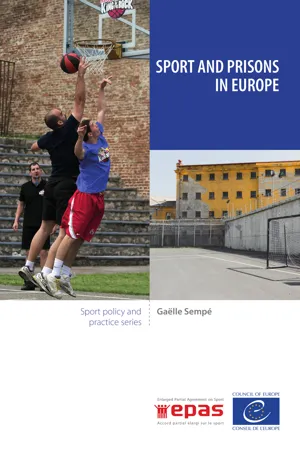
Sport and prisons in Europe
About this book
Information
Subtopic
Criminal LawIndex
LawTable of contents
- Cover
- Title page
- Contents
- Foreword by Stanislas Frossard, Executive Secretary of EPAS
- Foreword by Vivian Geiran, Chair of the PC-CP
- Preface
- Introduction
- Chapter 1. Survey of sport in European prisons
- Chapter 2. Capitalising on the social uses of sport in prison through “good practices”
- Chapter 3. Overview and critical perspective
- In conclusion
- Bibliography
- Copyright
- Table of contents
Trusted by 375,005 students
Access to over 1.5 million titles for a fair monthly price.
Study more efficiently using our study tools.
Frequently asked questions
Yes, you can cancel anytime from the Subscription tab in your account settings on the Perlego website. Your subscription will stay active until the end of your current billing period. Learn how to cancel your subscription
No, books cannot be downloaded as external files, such as PDFs, for use outside of Perlego. However, you can download books within the Perlego app for offline reading on mobile or tablet. Learn how to download books offline
Perlego offers two plans: Essential and Complete
- Essential is ideal for learners and professionals who enjoy exploring a wide range of subjects. Access the Essential Library with 800,000+ trusted titles and best-sellers across business, personal growth, and the humanities. Includes unlimited reading time and Standard Read Aloud voice.
- Complete: Perfect for advanced learners and researchers needing full, unrestricted access. Unlock 1.5M+ books across hundreds of subjects, including academic and specialized titles. The Complete Plan also includes advanced features like Premium Read Aloud and Research Assistant.
We are an online textbook subscription service, where you can get access to an entire online library for less than the price of a single book per month. With over 1.5 million books across 990+ topics, we’ve got you covered! Learn about our mission
Look out for the read-aloud symbol on your next book to see if you can listen to it. The read-aloud tool reads text aloud for you, highlighting the text as it is being read. You can pause it, speed it up and slow it down. Learn more about Read Aloud
Yes! You can use the Perlego app on both iOS and Android devices to read anytime, anywhere — even offline. Perfect for commutes or when you’re on the go.
Please note we cannot support devices running on iOS 13 and Android 7 or earlier. Learn more about using the app
Please note we cannot support devices running on iOS 13 and Android 7 or earlier. Learn more about using the app
Yes, you can access Sport and prisons in Europe by Gaëlle Sempé in PDF and/or ePUB format, as well as other popular books in Law & Criminal Law. We have over 1.5 million books available in our catalogue for you to explore.