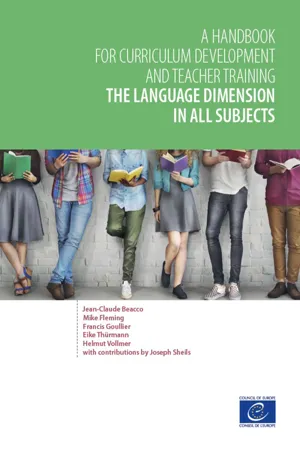
eBook - ePub
The language dimension in all subjects
A handbook for curriculum development and teacher training
- English
- ePUB (mobile friendly)
- Available on iOS & Android
eBook - ePub
The language dimension in all subjects
A handbook for curriculum development and teacher training
About this book
Mastering the language of schooling is essential for learners to develop the skills necessary for school success and for critical thinking. It is fundamental for participation in democratic societies, and for social inclusion and cohesion.
This handbook is a policy and working document which promotes convergence and coherence between the linguistic dimensions of various school subjects. It proposes measures to make explicit – in curricula, pedagogic material and teacher training – the specific linguistic norms and competences which learners must master in each school subject. It also presents the learning modalities that should allow all learners, and in particular the most vulnerable among them, to benefit from diversified language-learning situations in order to develop their cognitive and linguistic capacities.
Information
Table of contents
- Cover
- Title page
- Copyright page
- Preface
- Introduction
- Chapter 1: The language dimension in all subjects: an important issue for quality and equity in education
- Chapter 2: The role of language in the construction and application of knowledge
- Chapter 3: Forms of classroom communication and the acquisition of subject-specific knowledge
- Chapter 4: Acquiring a command of academic expression
- Chapter 5: Language diversity, subject literacy and academic achievement
- Chapter 6: Building up a command of the language of schooling during primary education
- Chapter 7: Language as subject
- Chapter 8: Subject-specific language requirements in secondary education
- Chapter 9: Teaching approaches
- Chapter 10: Curriculum development
- Chapter 11: The language dimension in initial teacher training and continuous professional development
- Chapter 12: The quality of training related to the linguistic dimensions of subject-specific teaching
- Conclusion
- Appendices
Trusted by 375,005 students
Access to over 1.5 million titles for a fair monthly price.
Study more efficiently using our study tools.
Frequently asked questions
Yes, you can cancel anytime from the Subscription tab in your account settings on the Perlego website. Your subscription will stay active until the end of your current billing period. Learn how to cancel your subscription
No, books cannot be downloaded as external files, such as PDFs, for use outside of Perlego. However, you can download books within the Perlego app for offline reading on mobile or tablet. Learn how to download books offline
We are an online textbook subscription service, where you can get access to an entire online library for less than the price of a single book per month. With over 1.5 million books across 990+ topics, we’ve got you covered! Learn about our mission
Look out for the read-aloud symbol on your next book to see if you can listen to it. The read-aloud tool reads text aloud for you, highlighting the text as it is being read. You can pause it, speed it up and slow it down. Learn more about Read Aloud
Yes! You can use the Perlego app on both iOS and Android devices to read anytime, anywhere — even offline. Perfect for commutes or when you’re on the go.
Please note we cannot support devices running on iOS 13 and Android 7 or earlier. Learn more about using the app
Please note we cannot support devices running on iOS 13 and Android 7 or earlier. Learn more about using the app
Yes, you can access The language dimension in all subjects by Jean-Claude Beacco,Mike Fleming,Francis Goullier,Eike Thürmann,Helmut Vollmer,Joseph Sheils in PDF and/or ePUB format, as well as other popular books in Languages & Linguistics & Education Theory & Practice. We have over 1.5 million books available in our catalogue for you to explore.