Unlock the more straightforward side of The Myth of Sisyphus with this concise and insightful summary and analysis!
This engaging summary presents an analysis of The Myth of Sisyphus by Albert Camus, a philosophical essay which focuses on the issue of suicide in an absurd world. Camus uses Greek mythology to highlight why life, in spite of its inherent pointlessness, is still worth living, coming to the conclusion that revolt is the only way to live in such an absurd world. First published in France in 1942, The Myth of Sisyphus is a part of Camus' cycle of the absurd and can be seen as a companion to The Stranger. Camus himself was born in French Algeria in 1913 and, despite often being liked to Sartre, never identified as an existentialist. He was highly regarded as a prominent absurdist philosopher, and in 1957 won the Nobel Prize in Literature.
Find out everything you need to know about The Myth of Sisyphus in a fraction of the time!
This in-depth and informative reading guide brings you:
• A complete plot summary
• Character studies
• Key themes and symbols
• Questions for further reflection
Why choose BrightSummaries.com?
Available in print and digital format, our publications are designed to accompany you on your reading journey. The clear and concise style makes for easy understanding, providing the perfect opportunity to improve your literary knowledge in no time.
See the very best of literature in a whole new light with BrightSummaries.com!
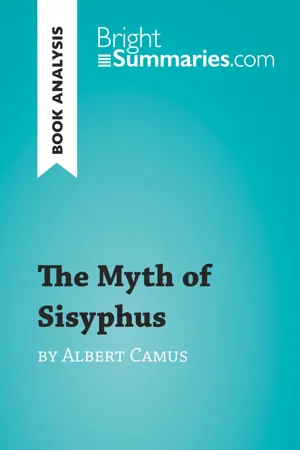
eBook - ePub
The Myth of Sisyphus by Albert Camus (Book Analysis)
Detailed Summary, Analysis and Reading Guide
- English
- ePUB (mobile friendly)
- Available on iOS & Android
eBook - ePub
The Myth of Sisyphus by Albert Camus (Book Analysis)
Detailed Summary, Analysis and Reading Guide
About this book
Information
Table of contents
- Albert Camus
- The Myth of Sisyphus
- Summary
- Context
- Analysis
- Further reflection
- Further reading
Trusted by 375,005 students
Access to over 1.5 million titles for a fair monthly price.
Study more efficiently using our study tools.
Frequently asked questions
Yes, you can cancel anytime from the Subscription tab in your account settings on the Perlego website. Your subscription will stay active until the end of your current billing period. Learn how to cancel your subscription
No, books cannot be downloaded as external files, such as PDFs, for use outside of Perlego. However, you can download books within the Perlego app for offline reading on mobile or tablet. Learn how to download books offline
Perlego offers two plans: Essential and Complete
- Essential is ideal for learners and professionals who enjoy exploring a wide range of subjects. Access the Essential Library with 800,000+ trusted titles and best-sellers across business, personal growth, and the humanities. Includes unlimited reading time and Standard Read Aloud voice.
- Complete: Perfect for advanced learners and researchers needing full, unrestricted access. Unlock 1.5M+ books across hundreds of subjects, including academic and specialized titles. The Complete Plan also includes advanced features like Premium Read Aloud and Research Assistant.
We are an online textbook subscription service, where you can get access to an entire online library for less than the price of a single book per month. With over 1.5 million books across 990+ topics, we’ve got you covered! Learn about our mission
Look out for the read-aloud symbol on your next book to see if you can listen to it. The read-aloud tool reads text aloud for you, highlighting the text as it is being read. You can pause it, speed it up and slow it down. Learn more about Read Aloud
Yes! You can use the Perlego app on both iOS and Android devices to read anytime, anywhere — even offline. Perfect for commutes or when you’re on the go.
Please note we cannot support devices running on iOS 13 and Android 7 or earlier. Learn more about using the app
Please note we cannot support devices running on iOS 13 and Android 7 or earlier. Learn more about using the app
Yes, you can access The Myth of Sisyphus by Albert Camus (Book Analysis) by Bright Summaries in PDF and/or ePUB format, as well as other popular books in Literature & French Literary Criticism. We have over 1.5 million books available in our catalogue for you to explore.