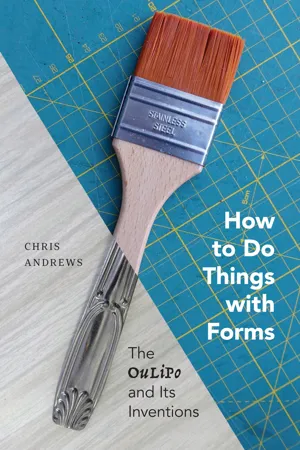
The Oulipo (Ouvroir de littérature potentielle, or Workshop for Potential Literature) is a literary think tank that brings together writers and mathematicians. Since 1960, its worldwide influence has refreshed ways of making and thinking about literature.
How to Do Things with Forms assesses the work of the group, explores where it came from, and envisages its future. Redefining the Oulipo's key concept of the constraint in a clear and rigorous way, Chris Andrews weighs the roles of craft and imitation in the group's practice. He highlights the importance of translation for the Oulipo's writers, explaining how their new forms convey meanings and how these famously playful authors are also moved by serious concerns. Offering fresh interpretations of emblematic Oulipian works such as Georges Perec's Life: A User's Manual, Andrews also examines lesser-known texts by Jacques Roubaud, Anne F. Garréta, and Michelle Grangaud.
How to Do Things with Forms addresses questions of interest to anyone involved in the making of literature, illuminating how writers decide when to stop revising, the risks and benefits of a project mentality in creative writing, and ways of holding a reader's interest for as long as possible.
- English
- ePUB (mobile friendly)
- Available on iOS & Android
eBook - ePub
About this book
Information
Publisher
McGill-Queen's University PressYear
2022Print ISBN
9780228011637
9780228011415
eBook ISBN
9780228012436
Table of contents
- Cover
- Copyright
- Contents
- Tables and Figures
- Acknowledgments
- Abbreviations
- Note on Translations
- Members of the Oulipo(by Year of Co-optation)
- Introduction
- 1 What the Oulipo Was Not
- 2 Kinds of Rules
- 3 Automation, Craft, and Imitation
- 4 Manipulation, Translation, and Composition
- 5 Meaningful Forms and Clinamen
- 6 Revelation and Dissimulation
- 7 Games Gone Wrong
- 8 Potentiality, Uptake, and Spread
- 9 What Has Become of the Oulipo?
- Notes
- Bibliography
- Index
Trusted by 375,005 students
Access to over 1.5 million titles for a fair monthly price.
Study more efficiently using our study tools.
Frequently asked questions
Yes, you can cancel anytime from the Subscription tab in your account settings on the Perlego website. Your subscription will stay active until the end of your current billing period. Learn how to cancel your subscription
No, books cannot be downloaded as external files, such as PDFs, for use outside of Perlego. However, you can download books within the Perlego app for offline reading on mobile or tablet. Learn how to download books offline
Perlego offers two plans: Essential and Complete
- Essential is ideal for learners and professionals who enjoy exploring a wide range of subjects. Access the Essential Library with 800,000+ trusted titles and best-sellers across business, personal growth, and the humanities. Includes unlimited reading time and Standard Read Aloud voice.
- Complete: Perfect for advanced learners and researchers needing full, unrestricted access. Unlock 1.5M+ books across hundreds of subjects, including academic and specialized titles. The Complete Plan also includes advanced features like Premium Read Aloud and Research Assistant.
We are an online textbook subscription service, where you can get access to an entire online library for less than the price of a single book per month. With over 1.5 million books across 990+ topics, we’ve got you covered! Learn about our mission
Look out for the read-aloud symbol on your next book to see if you can listen to it. The read-aloud tool reads text aloud for you, highlighting the text as it is being read. You can pause it, speed it up and slow it down. Learn more about Read Aloud
Yes! You can use the Perlego app on both iOS and Android devices to read anytime, anywhere — even offline. Perfect for commutes or when you’re on the go.
Please note we cannot support devices running on iOS 13 and Android 7 or earlier. Learn more about using the app
Please note we cannot support devices running on iOS 13 and Android 7 or earlier. Learn more about using the app
Yes, you can access How to Do Things with Forms by Chris Andrews in PDF and/or ePUB format, as well as other popular books in Literature & Literary Criticism. We have over 1.5 million books available in our catalogue for you to explore.