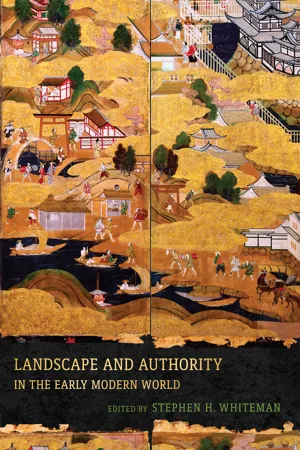
Courts and societies across the early modern Eurasian world were fundamentally transformed by the physical, technological, and conceptual developments of their era. Evolving forms of communication, greatly expanded mobility, the spread of scientific knowledge, and the emergence of an increasingly integrated global economy all affected how states articulated and projected visions of authority into societies that, in turn, perceived and responded to these visions in often contrasting terms. Landscape both reflected and served as a vehicle for these transformations, as the relationship between the land and its imagination and consumption became a fruitful site for the negotiation of imperial identities within and beyond the precincts of the court.
In Landscape and Authority in the Early Modern World, contributors explore the role of landscape in the articulation and expression of imperial identity and the mediation of relationships between the court and its many audiences in the early modern world. Nine studies focused on the geographical areas of East and South Asia, the Islamic world, and Europe illuminate how early modern courts and societies shaped, and were shaped by, the landscape, including both physical sites, such as gardens, palaces, cities, and hunting parks, and conceptual ones, such as those of frontiers, idealized polities, and the cosmos.
The collected essays expand the meaning and potential of landscape as a communicative medium in this period by putting an array of forms and subjects in dialogue with one another, including not only unique expressions, such as gardens, paintings, and manuscripts, but also the products of rapidly developing commercial technologies of reproduction, especially print. The volume invites a deeper and more nuanced understanding of the complexity with which early modern states constructed and deployed different modes of landscape for different audiences and environments.
Contributors: Robert Batchelor, Seyed Mohammad Ali Emrani, John Finlay, Caroline Fowler, Katrina Grant, Finola O'Kane, Anton Schweizer, Larry Silver, Stephen H. Whiteman.
eBook - ePub
Landscape and Authority in the Early Modern World
- 448 pages
- English
- ePUB (mobile friendly)
- Available on iOS & Android
eBook - ePub
Landscape and Authority in the Early Modern World
About this book
Information
Topic
ArchitectureSubtopic
History of ArchitectureTable of contents
- Cover
- Series Page
- Title Page
- Copyright
- Contents
- Acknowledgments
- Chapter 1. Connective Landscapes: Mobilizing Space in the Transcultural Early Modern
- Part I. Circulating Discourses
- Part II. Constructing Identities
- Part III. Defining Margins
- Part IV. Imagining Spaces
- Color illustrations
- Contributors
- Index
Trusted by 375,005 students
Access to over 1.5 million titles for a fair monthly price.
Study more efficiently using our study tools.
Frequently asked questions
Yes, you can cancel anytime from the Subscription tab in your account settings on the Perlego website. Your subscription will stay active until the end of your current billing period. Learn how to cancel your subscription
No, books cannot be downloaded as external files, such as PDFs, for use outside of Perlego. However, you can download books within the Perlego app for offline reading on mobile or tablet. Learn how to download books offline
We are an online textbook subscription service, where you can get access to an entire online library for less than the price of a single book per month. With over 1.5 million books across 990+ topics, we’ve got you covered! Learn about our mission
Look out for the read-aloud symbol on your next book to see if you can listen to it. The read-aloud tool reads text aloud for you, highlighting the text as it is being read. You can pause it, speed it up and slow it down. Learn more about Read Aloud
Yes! You can use the Perlego app on both iOS and Android devices to read anytime, anywhere — even offline. Perfect for commutes or when you’re on the go.
Please note we cannot support devices running on iOS 13 and Android 7 or earlier. Learn more about using the app
Please note we cannot support devices running on iOS 13 and Android 7 or earlier. Learn more about using the app
Yes, you can access Landscape and Authority in the Early Modern World by Stephen H. Whiteman, John Dixon Hunt,Elizabeth Hyde in PDF and/or ePUB format, as well as other popular books in Architecture & History of Architecture. We have over 1.5 million books available in our catalogue for you to explore.