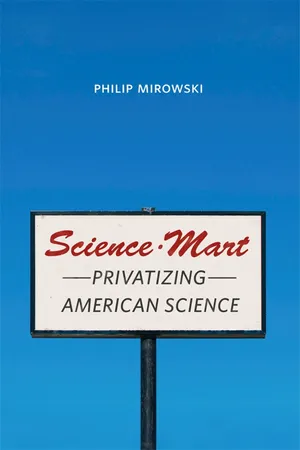
This trenchant study analyzes the rise and decline in the quality and format of science in America since World War II.
During the Cold War, the U.S. government amply funded basic research in science and medicine. Starting in the 1980s, however, this support began to decline and for-profit corporations became the largest funders of research. Philip Mirowski argues that a powerful neoliberal ideology promoted a radically different view of knowledge and discovery: the fruits of scientific investigation are not a public good that should be freely available to all, but are commodities that could be monetized.
Consequently, patent and intellectual property laws were greatly strengthened, universities demanded patents on the discoveries of their faculty, information sharing among researchers was impeded, and the line between universities and corporations began to blur. At the same time, corporations shed their in-house research laboratories, contracting with independent firms both in the States and abroad to supply new products. Among such firms were AT&T and IBM, whose outstanding research laboratories during much of the twentieth century produced Nobel Prize–winning work in chemistry and physics, ranging from the transistor to superconductivity.
Science-Mart offers a provocative, learned, and timely critique, of interest to anyone concerned that American science—once the envy of the world—must be more than just another way to make money.
- 463 pages
- English
- PDF
- Available on iOS & Android
eBook - PDF
About this book
Information
Topic
PhilosophySubtopic
Economic HistoryTable of contents
- Cover
- Title Page
- Copyright
- Contents
- Chapter 1. Viridiana Jones and the Temple of Mammon; Or, Adventures in Neoliberal Science Studies
- Part I. Why We Should Not Depend Upon the Existing Content of an “Economics of Science”
- Part II. A Modern Economic History of Science Organization
- Part III. Where We Are Headed
- Notes
- Bibliography
- Acknowledgments
- Index
Trusted by 375,005 students
Access to over 1.5 million titles for a fair monthly price.
Study more efficiently using our study tools.
Frequently asked questions
Yes, you can cancel anytime from the Subscription tab in your account settings on the Perlego website. Your subscription will stay active until the end of your current billing period. Learn how to cancel your subscription
No, books cannot be downloaded as external files, such as PDFs, for use outside of Perlego. However, you can download books within the Perlego app for offline reading on mobile or tablet. Learn how to download books offline
Perlego offers two plans: Essential and Complete
- Essential is ideal for learners and professionals who enjoy exploring a wide range of subjects. Access the Essential Library with 800,000+ trusted titles and best-sellers across business, personal growth, and the humanities. Includes unlimited reading time and Standard Read Aloud voice.
- Complete: Perfect for advanced learners and researchers needing full, unrestricted access. Unlock 1.5M+ books across hundreds of subjects, including academic and specialized titles. The Complete Plan also includes advanced features like Premium Read Aloud and Research Assistant.
We are an online textbook subscription service, where you can get access to an entire online library for less than the price of a single book per month. With over 1.5 million books across 990+ topics, we’ve got you covered! Learn about our mission
Look out for the read-aloud symbol on your next book to see if you can listen to it. The read-aloud tool reads text aloud for you, highlighting the text as it is being read. You can pause it, speed it up and slow it down. Learn more about Read Aloud
Yes! You can use the Perlego app on both iOS and Android devices to read anytime, anywhere — even offline. Perfect for commutes or when you’re on the go.
Please note we cannot support devices running on iOS 13 and Android 7 or earlier. Learn more about using the app
Please note we cannot support devices running on iOS 13 and Android 7 or earlier. Learn more about using the app
Yes, you can access Science-Mart by Philip Mirowski in PDF and/or ePUB format, as well as other popular books in Philosophy & Economic History. We have over 1.5 million books available in our catalogue for you to explore.