- English
- PDF
- Available on iOS & Android
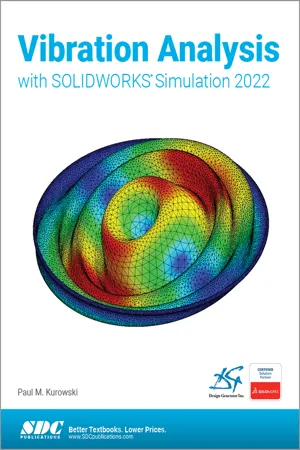
Vibration Analysis with SOLIDWORKS Simulation 2022
About this book
- Introduces you to both vibration analysis and its implementation in SOLIDWORKS Simulation 2022
- Covers all types of vibration analysis available in SOLIDWORKS Simulation
- Uses hands on exercises that build on one another throughout the book
- Designed for users already familiar with Finite Element Analysis using SOLIDWORKS Simulation
Vibration Analysis with SOLIDWORKS Simulation 2022 goes beyond the standard software manual. It concurrently introduces the reader to vibration analysis and its implementation in SOLIDWORKS Simulation using hands-on exercises. A number of projects are presented to illustrate vibration analysis and related topics. Each chapter is designed to build on the skills and understanding gained from previous exercises.
Vibration Analysis with SOLIDWORKS Simulation 2022 is designed for users who are already familiar with the basics of Finite Element Analysis (FEA) using SOLIDWORKS Simulation or who have completed the book Engineering Analysis with SOLIDWORKS Simulation 2022. Vibration Analysis with SOLIDWORKS Simulation 2022 builds on these topics in the area of vibration analysis. Some understanding of structural analysis and solid mechanics is recommended.
Topics Covered
- Differences between rigid and elastic bodies
- Discrete and distributed vibration systems
- Modal analysis and its applications
- Modal Superposition Method
- Modal Time History (Time Response) analysis
- Harmonic (Frequency Response) analysis
- Random Vibration analysis
- Response Spectrum analysis
- Nonlinear Vibration analysis
- Modeling techniques in vibration analysis
Frequently asked questions
- Essential is ideal for learners and professionals who enjoy exploring a wide range of subjects. Access the Essential Library with 800,000+ trusted titles and best-sellers across business, personal growth, and the humanities. Includes unlimited reading time and Standard Read Aloud voice.
- Complete: Perfect for advanced learners and researchers needing full, unrestricted access. Unlock 1.4M+ books across hundreds of subjects, including academic and specialized titles. The Complete Plan also includes advanced features like Premium Read Aloud and Research Assistant.
Please note we cannot support devices running on iOS 13 and Android 7 or earlier. Learn more about using the app.
Information
Table of contents
- Title Page
- Copyright
- Table of contents
- Before you start
- Chapter 1: Introduction to vibration analysis
- Chapter 2: Introduction to modal analysis
- Chapter 3: Modal analysis of distributed systems
- Chapter 4: Modal analysis with pre-stress
- Chapter 5: Modal analysis - properties of lower and higher modes
- Chapter 6: Modal analysis โ mass participation, properties of modes
- Chapter 7: Modal analysis โ mode separation
- Chapter 8: Modal analysis of axi-symmetric structures
- Chapter 9: Modal analysis โ locating structurally weak spots
- Chapter 10: Modal analysis - a diagnostic tool
- Chapter 11: Time response and frequency response of discrete systems
- Chapter 12: Harmonic base excitation of distributed systems
- Chapter 13: Omega square harmonic force excitation
- Chapter 14: Time response analysis, resonance, beating
- Chapter 15: Vibration absorption
- Chapter 16: Random vibration
- Chapter 17: Response spectrum analysis
- Chapter 18: Nonlinear vibration
- Chapter 19: Vibration benchmarks
- 20: Glossary of terms
- 21: References
- 22: List of exercises