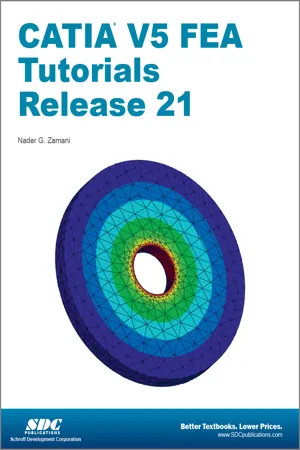
CATIA V5 FEA Tutorials Release 21
About this book
- Introduces new users to the Finite Element Analysis capabilities of CATIA 21
- Covers a wide variety of problems using step by step tutorials
- Each chapter is completely independent of each other
- Intended for people already familiar with the basics of using CATIA
The objective of this tutorial book is to expose the reader to the basic FEA capabilities in CATIA V5 Release 21. The chapters are designed to be independent of each other allowing the user to pick specific topics without the need to go through the previous chapters. However, the best strategy to learn is to sequentially cover the chapters.
In this workbook, the parts created in CATIA are simple enough they can be modeled with minimal knowledge of this powerful software. The reason behind the simplicity is not to burden the reader with the CAD aspects of the package. However, it is assumed that the user is familiar with CATIA V5 Release 21 interface and basic utilities such as pan, zoom, and rotation.
The tutorials are based on release 21; however, other releases can also be used with minor changes. Typically, the differences are not even noticed by a beginner.
Frequently asked questions
- Essential is ideal for learners and professionals who enjoy exploring a wide range of subjects. Access the Essential Library with 800,000+ trusted titles and best-sellers across business, personal growth, and the humanities. Includes unlimited reading time and Standard Read Aloud voice.
- Complete: Perfect for advanced learners and researchers needing full, unrestricted access. Unlock 1.4M+ books across hundreds of subjects, including academic and specialized titles. The Complete Plan also includes advanced features like Premium Read Aloud and Research Assistant.
Please note we cannot support devices running on iOS 13 and Android 7 or earlier. Learn more about using the app.
Information
Table of contents
- Title Page
- Copyright
- Preface
- Acknowledgments
- Table of Contents
- Chapter 1: Introduction
- Chapter 2: Analysis of a Bent Rod with Solid Elements
- Chapter 3: Axially Loaded Block with Stress Concentration
- Chapter 4: Stress Analysis of a Rotating Disk
- Chapter 5: Deformation of an I-beam under Self-weight
- Chapter 6: C-clamp Deformed with Enforced Displacement
- Chapter 7: FEA Modeling of the Bent Rod with Beam Elements
- Chapter 8: Beam Elements under Enforced Displacement
- Chapter 9: Bending of a Notched Specimen with Smooth Virtual Part
- Chapter 10: Analyzing a Loaded Bracket with Triangular Shell Elements
- Chapter 11: Modeling Mismatch in Shell Thickness and Surface Mesher
- Chapter 12: Analysis of Thin Walled Pressure Vessel using Shell Elements
- Chapter 13: Using the “Surface Mesher” to Simplify Geometry
- Chapter 14: FE Model of a Bearing-Shaft Assembly using Analysis Connection
- Chapter 15: Shrink Fit Analysis
- Chapter 16: Analysis of a Tensile Specimen as an Assembly
- Chapter 17: Analysis of a Fastened Assembly
- Chapter 18: Thermal Stresses in a Bi-metallic Strip
- Chapter 19: Hybrid Mesh Analysis
- Chapter 20: Spring Elements
- Chapter 21: Adaptive Refinement
- Chapter 22: Free Vibration of a Simply Supported Beam
- Chapter 23: Buckling Analysis
- Chapter 24: A Simple Spot Weld Analysis
- Chapter 25: Defining Restraints or Loads on Patches
- Chapter 26: Limited Hexahedral Element Capabilities
- Chapter 27: Frequency Response Analysis of a Simply Supported Beam
- Appendix I: Miscellaneous Comments
