eBook - ePub
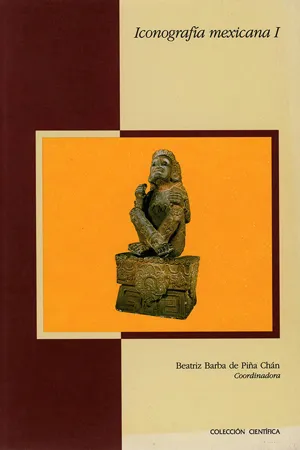
Iconografía mexicana I
Asun,
Trusted by 375,005 students
Access to over 1.5 million titles for a fair monthly price.
Study more efficiently using our study tools.
Information
Topic
EducationSubtopic
Education GeneralTable of contents
- Prefacio
- Introducción
- Los olmeca-xicallanca de Teotihuacan, Kaminaljuyú y Cacaxtla
- Disquisiciones sobre el ave falconiforme representada en Teotihuacan
- Inferencias de relaciones comerciales a través de la iconografía en Tula, Hidalgo (un sitio)
- ¿Fueron el Tlalocan de Teotihuacan y el Códice Borgia producto de la misma escuela de tlacuilos?
- Las flores alucinógenas del juego de pelota mesoamericano
- Atados para quemar
- Iconografía en Vasijas de Tepexi El Viejo, Puebla
- Iconografía de las deidades lunares huaxtecas
- Interpretación iconográfica de algunos moluscos en pictografías del Altiplano
- Las narigueras lunares de concha del Templo Mayor de Tenochtitlan
- Desmembramiento ritual en un petroglifo del templo mayor de Tlatelolco
- Simbolismo del monolito del monte Tláloc, Estado de México*
- Topónimos del Códice de Tlatelolco
- De cómo las diferentes fuentes históricas presentan a las deidades antiguas: el caso de Coatlicue y Coyolxauhqui
- Los nombres de los barrios de Tultitlán: un ejemplo de representación indocristiana
- Iconografía y sincretismo de los dioses nahuas en Ecatepec y sus pueblos
- Notas para el estudio de la iconografía de algunas deidades tlaxcaltecas: avances de investigación*
- Los trece signos de poder de China y Mesoamérica
Frequently asked questions
Yes, you can cancel anytime from the Subscription tab in your account settings on the Perlego website. Your subscription will stay active until the end of your current billing period. Learn how to cancel your subscription
No, books cannot be downloaded as external files, such as PDFs, for use outside of Perlego. However, you can download books within the Perlego app for offline reading on mobile or tablet. Learn how to download books offline
Perlego offers two plans: Essential and Complete
- Essential is ideal for learners and professionals who enjoy exploring a wide range of subjects. Access the Essential Library with 800,000+ trusted titles and best-sellers across business, personal growth, and the humanities. Includes unlimited reading time and Standard Read Aloud voice.
- Complete: Perfect for advanced learners and researchers needing full, unrestricted access. Unlock 1.5M+ books across hundreds of subjects, including academic and specialized titles. The Complete Plan also includes advanced features like Premium Read Aloud and Research Assistant.
We are an online textbook subscription service, where you can get access to an entire online library for less than the price of a single book per month. With over 1.5 million books across 990+ topics, we’ve got you covered! Learn about our mission
Look out for the read-aloud symbol on your next book to see if you can listen to it. The read-aloud tool reads text aloud for you, highlighting the text as it is being read. You can pause it, speed it up and slow it down. Learn more about Read Aloud
Yes! You can use the Perlego app on both iOS and Android devices to read anytime, anywhere — even offline. Perfect for commutes or when you’re on the go.
Please note we cannot support devices running on iOS 13 and Android 7 or earlier. Learn more about using the app
Please note we cannot support devices running on iOS 13 and Android 7 or earlier. Learn more about using the app
Yes, you can access Iconografía mexicana I by Francisco Rivas Castro,Jorge Angulo V.,Blanca Paredes G.,Cecilia Haupt,Beatriz Barba de Piña Chán,Román Piña Chán,Noemí Castillo Tejero,Nicola Kuehne Heyder,Lourdes Suárez Diez,Adrián Velázquez Castro,Salvador Guilliem Arroyo,Rubén B. Morante López,Perla Valle,Doris Heyden,Luis Córdoba Barradas,Asun in PDF and/or ePUB format, as well as other popular books in Education & Education General. We have over 1.5 million books available in our catalogue for you to explore.