A compelling alternative account of the history of knowledge from the Renaissance to the Enlightenment
Until now the history of knowledge has largely been about formal and documented accumulation, concentrating on systems, collections, academies, and institutions. The central narrative has been one of advancement, refinement, and expansion. Martin Mulsow tells a different story. Knowledge can be lost: manuscripts are burned, oral learning dies with its bearers, new ideas are suppressed by censors. Knowledge Lost is a history of efforts, from the Renaissance to the Enlightenment, to counter such loss. It describes how critics of ruling political and religious regimes developed tactics to preserve their views; how they buried their ideas in footnotes and allusions; how they circulated their tracts and treatises in handwritten copies; and how they commissioned younger scholars to spread their writings after death.
Filled with exciting stories, Knowledge Lost follows the trail of precarious knowledge through a series of richly detailed episodes. It deals not with the major themes of metaphysics and epistemology, but rather with interpretations of the Bible, Orientalism, and such marginal zones as magic. And it focuses not on the usual major thinkers, but rather on forgotten or half-forgotten members of the “knowledge underclass,” such as Pietro della Vecchia, a libertine painter and intellectual; Charles-César Baudelot, an antiquarian and numismatist; and Johann Christoph Wolf, a pastor, Hebrew scholar, and witness to the persecution of heretics.
Offering a fascinating new approach to the intellectual history of early modern Europe, Knowledge Lost is also an ambitious attempt to rethink the very concept of knowledge.
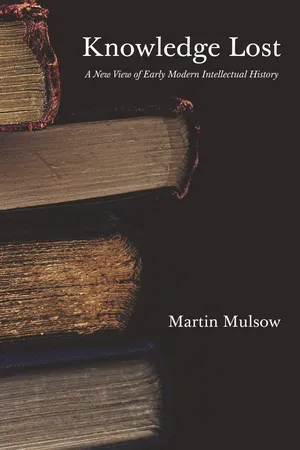
eBook - ePub
Knowledge Lost
A New View of Early Modern Intellectual History
- 456 pages
- English
- ePUB (mobile friendly)
- Available on iOS & Android
eBook - ePub
About this book
Information
Publisher
Princeton University PressYear
2022Print ISBN
9780691244112
9780691208657
eBook ISBN
9780691244129
Table of contents
- Cover Page
- Title Page
- Copyright Page
- Dedication
- Contents
- List of Illustrations
- Preface
- Introduction: Precarious Knowledge, Dangerous Transfers, and the Materiality of Knowing
- Part I. Tactics of the Intellectual Precariat
- Part II. Fragility and Engagement in the Knowledge Bourgeoisie
- Concluding Word
- Index
Trusted by 375,005 students
Access to over 1.5 million titles for a fair monthly price.
Study more efficiently using our study tools.
Frequently asked questions
Yes, you can cancel anytime from the Subscription tab in your account settings on the Perlego website. Your subscription will stay active until the end of your current billing period. Learn how to cancel your subscription
No, books cannot be downloaded as external files, such as PDFs, for use outside of Perlego. However, you can download books within the Perlego app for offline reading on mobile or tablet. Learn how to download books offline
Perlego offers two plans: Essential and Complete
- Essential is ideal for learners and professionals who enjoy exploring a wide range of subjects. Access the Essential Library with 800,000+ trusted titles and best-sellers across business, personal growth, and the humanities. Includes unlimited reading time and Standard Read Aloud voice.
- Complete: Perfect for advanced learners and researchers needing full, unrestricted access. Unlock 1.5M+ books across hundreds of subjects, including academic and specialized titles. The Complete Plan also includes advanced features like Premium Read Aloud and Research Assistant.
We are an online textbook subscription service, where you can get access to an entire online library for less than the price of a single book per month. With over 1.5 million books across 990+ topics, we’ve got you covered! Learn about our mission
Look out for the read-aloud symbol on your next book to see if you can listen to it. The read-aloud tool reads text aloud for you, highlighting the text as it is being read. You can pause it, speed it up and slow it down. Learn more about Read Aloud
Yes! You can use the Perlego app on both iOS and Android devices to read anytime, anywhere — even offline. Perfect for commutes or when you’re on the go.
Please note we cannot support devices running on iOS 13 and Android 7 or earlier. Learn more about using the app
Please note we cannot support devices running on iOS 13 and Android 7 or earlier. Learn more about using the app
Yes, you can access Knowledge Lost by Martin Mulsow, H. C. Erik Midelfort in PDF and/or ePUB format, as well as other popular books in History & Early Modern History. We have over 1.5 million books available in our catalogue for you to explore.