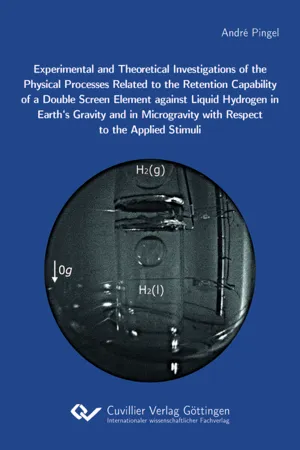
Metal screens are commonly used as components for fluid handling in spacecraft and rocket tank designs. In most cases, the screens perform a passive separation of the propellant phases. The separation of the liquid from the gaseous propellant phase, is a special challenge. Liquid-gas phase separation means that the gaseous phase is allowed to enter a phase separation device while the liquid phase is blocked. The technical application of this process is the depressurization in a propellant tank. A certain amount of the gaseous propellant phase is vented from the tank through the gas port. The liquid propellant phase remains in the tank in order to be stored for the engine. However, if the tank causes a liquid movement during the depressurization, a part of the liquid can potentially enter the gas port. In order to prevent the unwanted liquid outflow, a separation of the liquid from the gas is necessary. This is possible with the aid of a double screen element and has already been performed for storable liquids in Earth's gravity and microgravity as well as for cryogenic liquids in Earth's gravity. At the current state of the art, the separation of the liquid from the gaseous phase of the cryogenic propellant hydrogen using a double screen element has not been performed in microgravity. However, with regard to a possible application, it is mandatory to investigate the function of the double screen element for the real propellant under relevant environmental conditions.In this work, a cryogenic test facility has been developed and operated successfully under Earth's gravity and microgravity conditions using the drop tower at the University of Bremen. Hereby, the original, cryogenic propellant phases: liquid and gaseous hydrogen, have been used. The experiments show the appearance of the physical processes which are related to the retention capability of a double screen element against liquid hydrogen. Furthermore, these physical processes can obviously be influenced by an unknown boundary condition at the screens: the screen saturation. This unknown boundary condition in turn can obviously be influenced by a certain stimulus which causes a special, fluid mechanical process.A simplified mathematical and two numerical models have been developed which combine the observed, physical processes in the experiments. Two fitting parameters are introduced which influence the flow through screen pressure loss of the liquid and the gaseous hydrogen phase. After the fitting to experimental data, the two fitting parameters have been interpreted with respect to a possible screen saturation. The results lead to a prediction of the unknown boundary condition and indicate that a partial saturation of the screens with liquid could be present in each considered experiment. This can possibly lead to a major influence of the overall resistance of the double screen element against liquid hydrogen.
- 400 pages
- English
- PDF
- Available on iOS & Android
eBook - PDF
About this book
Information
Print ISBN
9783736976429
Edition
1Table of contents
- List of symbols
- List of simulations
- Chapter 1 Introduction
- 1.1 Background
- 1.2 Motivation
- 1.3 Challenges
- 1.4 Expected physical processes in microgravity
- 1.5 Expected physical processes in Earth's gravity
- 1.6 Outline
- Chapter 2 Theoretical background
- 2.1 General accounting equations
- 2.2 General mass conservation equations
- 2.3 General linear momentum conservation equations
- 2.4 General, internal energy conservation equations
- 2.5 Heat transfer
- 2.6 Initial conditions, boundary conditions and appro-ximations
- Chapter 3 Numerical background
- 3.1 Mass conservation equations
- 3.2 Momentum conservation equations
- 3.3 Fluid internal energy conservation equations
- 3.4 Solid energy conservation equations
- 3.5 Boundary conditions
- 3.6 Surface tension with wall adhesion
- 3.7 Phase change mass ux at a free surface
- 3.8 Solution method
- Chapter 4 State of the art
- 4.1 Flow through porous media
- 4.2 Joule-Thomson eect at porous media
- 4.3 Radial wicking
- 4.4 Bubble point pressure
- 4.5 Capillary static of liquid-gas interfaces
- 4.6 Capillary driven liquid rise in a cylindrical tube
- 4.7 Evaporation and condensation at free surfaces
- Chapter 5 Numerical simulation of governingphysical processes
- 5.1 Macroscopic ow through screen pressure loss
- 5.2 Macroscopic radial inward wicking
- 5.3 Macroscopic bubble point pressure
- 5.4 Macroscopic capillary driven liquid rise in a cylin-drical tube
- Chapter 6 Experiments
- 6.1 Experimental setup
- 6.2 Results in microgravity
- 6.3 Results in Earth's gravity
- 6.4 Comparison between experiments in Earth's gravityand microgravity
- 6.5 Eects of the applied stimuli
- 6.6 Possible error sources
- 6.7 Conclusion
- Chapter 7 Mathematical model
- 7.1 Assumptions
- 7.2 Liquid rise below the double screen element
- 7.3 Enclosed gas volume of the bubble below the lowerscreen in microgravity
- 7.4 Liquid rise between the screens of the double screenelement
- 7.5 Enclosed gas volume of the bubble below the upperscreen in microgravity
- 7.6 Liquid rise above the double screen element
- 7.7 Results
- Chapter 8 Numerical model without phase change
- 8.1 General procedure
- 8.2 Numerical setup
- 8.3 Results
- Chapter 9 Numerical model with phase change
- 9.1 General procedure
- 9.2 Numerical setup
- 9.3 Results
- Chapter 10 Conclusion
- 10.1 Development and operation of a cryogenic test fa-cility in Earth's gravity and in microgravity
- 10.2 Theoretical investigation of the observed physicalprocesses, with respect to the applied stimuli
- Chapter 11 Outlook
- Appendix A
- A.1 Derivation of the analytical solution of the equationfor the simplied capillary rise into the tube belowthe double screen element in microgravity
- List of Figures
- List of Tables
- Bibliography
Trusted by 375,005 students
Access to over 1.5 million titles for a fair monthly price.
Study more efficiently using our study tools.