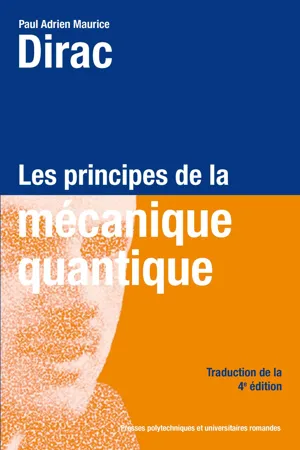
La physique quantique a pris son essor autour de 1925 avec les théories révolutionnaires de Louis de Broglie, de Werner Heisenberg et d’Erwin Schrödinger. Très vite P. A. M. Dirac, qui partage le prix Nobel de physique 1933 avec E. Schrödinger, contribue fortement à ces avancées et publie dès 1930 un traité, The principles of Quantum Mechanics, régulièrement révisé et amélioré. Sa dernière édition, aboutissement de trente sept ans de perfectionnements, est un ouvrage de référence de la littérature scientifique. Dirac y développe les fondements de la physique quantique avec notamment la présentation d’un formalisme novateur toujours utilisé actuellement (fonction delta, notation bra-ket...). Il y expose aussi la théorie relativiste de l’électron qui lui a permis de prédire l’existence des positons, les décrivant comme des lacunes dans une mer d’électrons. Le dernier chapitre est consacré à la présentation de l’électrodynamique quantique. Le présent ouvrage est une traduction de la 4e édition (1958) dans sa version révisée de 1967. C’est la première fois que cette édition est traduite en français. Traduction française de la version américaine par Vincent Faye et Sébastien Bréard, professeur de physique au lycée Victor Bérard, à Morez.
- 318 pages
- English
- PDF
- Available on iOS & Android
eBook - PDF
About this book
Information
Topic
Sciences physiquesSubtopic
PhysiqueTable of contents
- AVERTISSEMENT DE L’ÉDITEUR
- PRÉFACE DES TRADUCTEURS
- PRÉFACE DE LA QUATRIÈME ÉDITION
- EXTRAIT DE LA PRÉFACE DE LA PREMIÈRE ÉDITION
- TABLE DES MATIÈRES
- I PRINCIPE DE SUPERPOSITION
- II VARIABLES DYNAMIQUES ET OBSERVABLES
- III REPRÉSENTATIONS
- IV RÈGLES DE QUANTIFICATION
- V ÉQUATIONS DU MOUVEMENT
- VI APPLICATIONS ÉLÉMENTAIRES
- VII THÉORIE DES PERTURBATIONS
- VIII PROBLÈMES DE COLLISIONS
- IX SYSTÈMES CONTENANT PLUSIEURS PARTICULES IDENTIQUES
- X THÉORIE DU RAYONNEMENT
- XI THÉORIE RELATIVISTE DE L’ÉLECTRON
- XII ÉLECTRODYNAMIQUE QUANTIQUE
- Index
Trusted by 375,005 students
Access to over 1.5 million titles for a fair monthly price.
Study more efficiently using our study tools.
Frequently asked questions
Yes, you can cancel anytime from the Subscription tab in your account settings on the Perlego website. Your subscription will stay active until the end of your current billing period. Learn how to cancel your subscription
No, books cannot be downloaded as external files, such as PDFs, for use outside of Perlego. However, you can download books within the Perlego app for offline reading on mobile or tablet. Learn how to download books offline
Perlego offers two plans: Essential and Complete
- Essential is ideal for learners and professionals who enjoy exploring a wide range of subjects. Access the Essential Library with 800,000+ trusted titles and best-sellers across business, personal growth, and the humanities. Includes unlimited reading time and Standard Read Aloud voice.
- Complete: Perfect for advanced learners and researchers needing full, unrestricted access. Unlock 1.5M+ books across hundreds of subjects, including academic and specialized titles. The Complete Plan also includes advanced features like Premium Read Aloud and Research Assistant.
We are an online textbook subscription service, where you can get access to an entire online library for less than the price of a single book per month. With over 1.5 million books across 990+ topics, we’ve got you covered! Learn about our mission
Look out for the read-aloud symbol on your next book to see if you can listen to it. The read-aloud tool reads text aloud for you, highlighting the text as it is being read. You can pause it, speed it up and slow it down. Learn more about Read Aloud
Yes! You can use the Perlego app on both iOS and Android devices to read anytime, anywhere — even offline. Perfect for commutes or when you’re on the go.
Please note we cannot support devices running on iOS 13 and Android 7 or earlier. Learn more about using the app
Please note we cannot support devices running on iOS 13 and Android 7 or earlier. Learn more about using the app
Yes, you can access Les principes de la mécanique quantique by Paul Dirac in PDF and/or ePUB format, as well as other popular books in Sciences physiques & Physique. We have over 1.5 million books available in our catalogue for you to explore.