After the proclamation of the Truman Doctrine in 1947, the United States became deeply involved in Greek affairs. By 1952, however, the pro-Western government of Marshal Papagos began to support the nationalist 'Enosis' movement in Cyprus and called for an end to British colonial rule in the island. The opposition of the US, Britain and Turkey to these demands brought Greece face-to-face with its closest allies at the United Nations in 1954 and led to the outbreak of the first major crisis within NATO since its creation.
Greece and the Cold War examines these developments from the novel perspective of critical international theory and exposes the unexplored connections between dependence and nationalism in Greek foreign policy. Drawing on a wide range of American, British and Greek archival sources, it argues that nationalism and compliance with the collective interests of NATO were two irreconcilable objectives in Greek foreign policy after 1952. At the same time, the book tells the story of how the post-Civil War governments of Greece, for a variety of political, cultural and ideological reasons, treated these two objectives as essentially compatible, resulting in the adoption of a dualist policy. This self-contradictory diplomatic doctrine, which the author refers to as "dependent nationalism", lies at the heart of Greece's post-War failures both to emancipate its politics from US intervention and to peacefully end its regional dispute with Turkey over Cyprus.
The book deploys an interdisciplinary approach which brings together the diverse perspectives of diplomatic history, foreign policy analysis and political sociology.
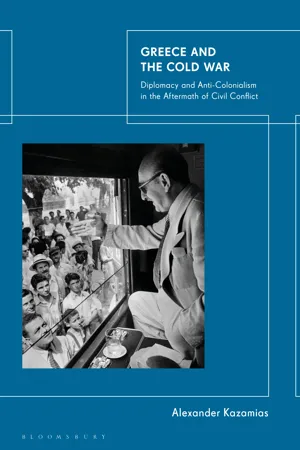
eBook - ePub
Greece and the Cold War
Diplomacy and Anti-Colonialism in the Aftermath of Civil Conflict
- 328 pages
- English
- ePUB (mobile friendly)
- Available on iOS & Android
eBook - ePub
Greece and the Cold War
Diplomacy and Anti-Colonialism in the Aftermath of Civil Conflict
About this book
Information
Table of contents
- Cover
- Halftitle Page
- Title Page
- Contents
- List of illustrations
- List of tables
- Acknowledgements
- Introduction
- 1 Conceptualizing the Dualism of Greek Foreign Policy
- 2 Hegemony, Dependence and the Us Policy Review of 1952
- 3 The Domestic Structures of the Post-Civil War Political System
- 4 From Dependence to Dualism: Cyprus Enters Greek Foreign Policy
- 5 Dependent Nationalism: ‘Operating Between Two Notions’
- 6 The Semi-Internationalization of the Cyprus Question: the Un Appeal
- 7 The Dualist Aspects of Foreign Economic Policy
- Conclusion
- Notes
- Bibliography
- Index
- Imprint
Trusted by 375,005 students
Access to over 1.5 million titles for a fair monthly price.
Study more efficiently using our study tools.
Frequently asked questions
Yes, you can cancel anytime from the Subscription tab in your account settings on the Perlego website. Your subscription will stay active until the end of your current billing period. Learn how to cancel your subscription
No, books cannot be downloaded as external files, such as PDFs, for use outside of Perlego. However, you can download books within the Perlego app for offline reading on mobile or tablet. Learn how to download books offline
We are an online textbook subscription service, where you can get access to an entire online library for less than the price of a single book per month. With over 1.5 million books across 990+ topics, we’ve got you covered! Learn about our mission
Look out for the read-aloud symbol on your next book to see if you can listen to it. The read-aloud tool reads text aloud for you, highlighting the text as it is being read. You can pause it, speed it up and slow it down. Learn more about Read Aloud
Yes! You can use the Perlego app on both iOS and Android devices to read anytime, anywhere — even offline. Perfect for commutes or when you’re on the go.
Please note we cannot support devices running on iOS 13 and Android 7 or earlier. Learn more about using the app
Please note we cannot support devices running on iOS 13 and Android 7 or earlier. Learn more about using the app
Yes, you can access Greece and the Cold War by Alexander Kazamias in PDF and/or ePUB format, as well as other popular books in History & 20th Century History. We have over 1.5 million books available in our catalogue for you to explore.