Domestic service has long been one of the largest forms of urban employment across southern Africa. Home economics provides the first comprehensive history of this essential sector in the decades following independence and the end of apartheid. Focusing on Lusaka and drawing wider comparisons, the book traces how Black workers and employers adapted existing models of domestic service as part of broader responses to changing gendered employment patterns, economic decline, and endemic poverty. It reveals how kin-based domestic service gradually displaced wage labour and how women and girl workers came to dominate kin-based and waged domestic service, with profound consequences for labour regulation and worker organising. Theoretically innovative and empirically rich, the book provides essential insights into debates about gender, work, and urban economies that are critical to understanding southern Africa's post-colonial and post-apartheid history.
This book is relevant to United Nations Sustainable Development Goal 8, Decent work and economic growth
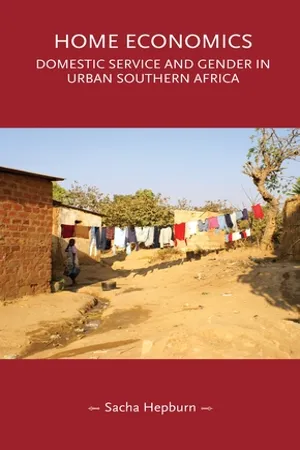
- 239 pages
- English
- ePUB (mobile friendly)
- Available on iOS & Android
eBook - ePub
About this book
Information
Table of contents
- Cover
- Half-Title
- Series
- Title
- Copyright
- Contents
- List of illustrations
- Acknowledgements
- Abbreviations
- Map of southern Africa
- Map of Lusaka
- Introduction
- 1 Feminising domestic service
- 2 Working women and childcare challenges
- 3 Girl domestic workers’ aspirations and frustrations
- 4 Regulation, protection, and exclusion
- 5 Collective organising and the limits of unionisation
- Conclusion
- Bibliography
- Index
Trusted by 375,005 students
Access to over 1.5 million titles for a fair monthly price.
Study more efficiently using our study tools.
Frequently asked questions
Yes, you can cancel anytime from the Subscription tab in your account settings on the Perlego website. Your subscription will stay active until the end of your current billing period. Learn how to cancel your subscription
No, books cannot be downloaded as external files, such as PDFs, for use outside of Perlego. However, you can download books within the Perlego app for offline reading on mobile or tablet. Learn how to download books offline
We are an online textbook subscription service, where you can get access to an entire online library for less than the price of a single book per month. With over 1.5 million books across 990+ topics, we’ve got you covered! Learn about our mission
Look out for the read-aloud symbol on your next book to see if you can listen to it. The read-aloud tool reads text aloud for you, highlighting the text as it is being read. You can pause it, speed it up and slow it down. Learn more about Read Aloud
Yes! You can use the Perlego app on both iOS and Android devices to read anytime, anywhere — even offline. Perfect for commutes or when you’re on the go.
Please note we cannot support devices running on iOS 13 and Android 7 or earlier. Learn more about using the app
Please note we cannot support devices running on iOS 13 and Android 7 or earlier. Learn more about using the app
Yes, you can access Home economics by Sacha Hepburn in PDF and/or ePUB format, as well as other popular books in History & Labour Economics. We have over 1.5 million books available in our catalogue for you to explore.