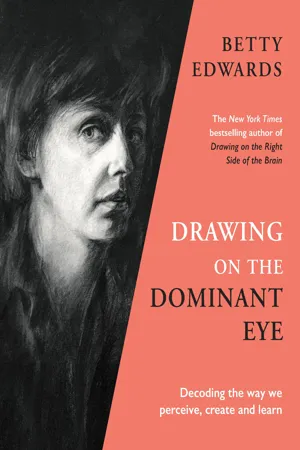
THE SEQUEL TO THE MULTI-MILLION BESTSELLER DRAWING ON THE RIGHT SIDE OF THE BRAIN From the author of the world's most popular drawing instruction manual Drawing on the Right Side of the Brain, this new book helps you discover a new way of drawing and problem solving.Betty Edwards reveals the role our dominant eye plays in how we perceive, create, and are seen by those around us. Research shows that much like being right-handed or left-handed, each of us has a dominant eye, corresponding to the dominant side of our brain - either verbal or perceptual. Once you learn the difference and try your hand at the simple drawing exercises, you'll gain fresh insights into how you perceive, think, and create. You'll learn how to not just look but truly see. Generously illustrated throughout, Drawing on the Dominant Eye offers a remarkable guided tour through art history, psychology, and the creative process; a must-read for anyone looking for a richer understanding of our art, our minds, and ourselves. Praise for Betty Edwards' Drawing on the Right Side of the Brain: 'Hands down the best and most life-enhancing thing I've done in lockdown' India Knight'A guide to enhancing creativity and artistic confidence' Independent
- English
- ePUB (mobile friendly)
- Available on iOS & Android
eBook - ePub
About this book
Information
Topic
Personal DevelopmentSubtopic
Art TechniquesTable of contents
- Cover
- Title Page
- Copyright
- Dedication
- Contents
- Acknowledgments
- A Note About the Cover Self-Portrait
- Introduction
- Chapter One: Two Ways of Seeing and Thinking
- Chapter Two: The Dominant Eye and the Brain
- Chapter Three: Human Faces and Expressions
- Chapter Four: Seeking and Finding the Dominant Eye
- Chapter Five: Drawing and the Symbolism of Eyes and Eyedness
- Chapter Six: Why Do We Make Portraits of Ourselves and Other People?
- Chapter Seven: Drawing Some Conclusions
- Glossary
- Bibliography
Trusted by 375,005 students
Access to over 1.5 million titles for a fair monthly price.
Study more efficiently using our study tools.
Frequently asked questions
Yes, you can cancel anytime from the Subscription tab in your account settings on the Perlego website. Your subscription will stay active until the end of your current billing period. Learn how to cancel your subscription
No, books cannot be downloaded as external files, such as PDFs, for use outside of Perlego. However, you can download books within the Perlego app for offline reading on mobile or tablet. Learn how to download books offline
Perlego offers two plans: Essential and Complete
- Essential is ideal for learners and professionals who enjoy exploring a wide range of subjects. Access the Essential Library with 800,000+ trusted titles and best-sellers across business, personal growth, and the humanities. Includes unlimited reading time and Standard Read Aloud voice.
- Complete: Perfect for advanced learners and researchers needing full, unrestricted access. Unlock 1.5M+ books across hundreds of subjects, including academic and specialized titles. The Complete Plan also includes advanced features like Premium Read Aloud and Research Assistant.
We are an online textbook subscription service, where you can get access to an entire online library for less than the price of a single book per month. With over 1.5 million books across 990+ topics, we’ve got you covered! Learn about our mission
Look out for the read-aloud symbol on your next book to see if you can listen to it. The read-aloud tool reads text aloud for you, highlighting the text as it is being read. You can pause it, speed it up and slow it down. Learn more about Read Aloud
Yes! You can use the Perlego app on both iOS and Android devices to read anytime, anywhere — even offline. Perfect for commutes or when you’re on the go.
Please note we cannot support devices running on iOS 13 and Android 7 or earlier. Learn more about using the app
Please note we cannot support devices running on iOS 13 and Android 7 or earlier. Learn more about using the app
Yes, you can access Drawing on the Dominant Eye by Betty Edwards in PDF and/or ePUB format, as well as other popular books in Personal Development & Art Techniques. We have over 1.5 million books available in our catalogue for you to explore.