eBook - ePub
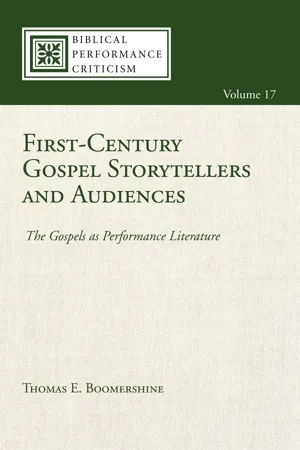
First-Century Gospel Storytellers and Audiences
The Gospels as Performance Literature
- 282 pages
- English
- ePUB (mobile friendly)
- Available on iOS & Android
eBook - ePub
First-Century Gospel Storytellers and Audiences
The Gospels as Performance Literature
About this book
These essays explore the reconception of the Gospels as first-century compositions of sound performed for audiences by storytellers rather than the anachronistic picture of a series of texts read by individual readers. The new paradigm implicit in these initial experiments is based on the recent realization that the majority of persons--85 to 95 percent--were illiterate and experienced the Jesus stories as members of audiences. Either from memory or from memorized manuscripts, the evangelists performed the Gospels as an evening's entertainment of two to four hours. The audiences were predominantly addressed as Hellenistic Judeans who lived in the aftermath of the Roman-Jewish war. When heard whole, the Gospels were vivid experiences of the central character of Jesus. These studies of audience address and the interactions between first-century storytellers and audiences reveal a dynamic performance literature that functioned as scripts for an ever-expanding network of storytelling proclamations whose envisioned horizon was the whole world. When the Gospels were told at one time from beginning to end, they invited the listeners to move from being peripherally interested or initially opposed to Jesus to identifying themselves as disciples of Jesus and believers in him as the Messiah.
Information
Table of contents
- Title Page
- Acknowledgments
- Abbreviations
- Introduction, Conclusions, and the Future
- Part I: Ancient Media Culture and the History of Biblical Interpretation
- Part II: Mark as Performance Literature
- Part III: Audience Address and Audience Identity in Mark and John
- Bibliography
Trusted by 375,005 students
Access to over 1.5 million titles for a fair monthly price.
Study more efficiently using our study tools.
Frequently asked questions
Yes, you can cancel anytime from the Subscription tab in your account settings on the Perlego website. Your subscription will stay active until the end of your current billing period. Learn how to cancel your subscription
No, books cannot be downloaded as external files, such as PDFs, for use outside of Perlego. However, you can download books within the Perlego app for offline reading on mobile or tablet. Learn how to download books offline
We are an online textbook subscription service, where you can get access to an entire online library for less than the price of a single book per month. With over 1.5 million books across 990+ topics, we’ve got you covered! Learn about our mission
Look out for the read-aloud symbol on your next book to see if you can listen to it. The read-aloud tool reads text aloud for you, highlighting the text as it is being read. You can pause it, speed it up and slow it down. Learn more about Read Aloud
Yes! You can use the Perlego app on both iOS and Android devices to read anytime, anywhere — even offline. Perfect for commutes or when you’re on the go.
Please note we cannot support devices running on iOS 13 and Android 7 or earlier. Learn more about using the app
Please note we cannot support devices running on iOS 13 and Android 7 or earlier. Learn more about using the app
Yes, you can access First-Century Gospel Storytellers and Audiences by Thomas E. Boomershine in PDF and/or ePUB format, as well as other popular books in Theology & Religion & Biblical Criticism & Interpretation. We have over 1.5 million books available in our catalogue for you to explore.