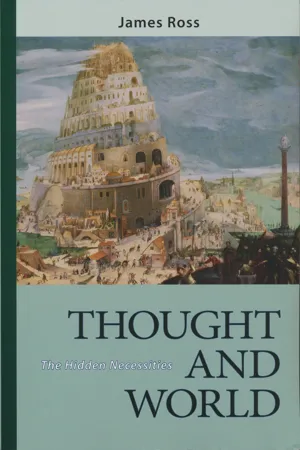
James F. Ross is a creative and independent thinker in contemporary metaphysics and philosophy of mind. In this concise metaphysical essay, he argues clearly and analytically that meaning, truth, impossibility, natural necessity, and our intelligent perception of nature fit together into a distinctly realist account of thought and world. Ross articulates a moderate realism about repeatable natural structures and our abstractive ability to discern them that poses a challenge to many of the common assumptions and claims of contemporary analytic philosophy. He develops a broadly Aristotelian metaphysics that recognizes the "hidden necessities" of things, which are disclosed through the sciences, which ground his account of real impossibility as a kind of vacuity, and which require the immateriality of the human ability to understand. Those ideas are supported by a novel account of false judgment. Ross aims to offer an analytically and historically respectable alternative to the prevailing positions of many British-American philosophers.
- 249 pages
- English
- PDF
- Available on iOS & Android
eBook - PDF
About this book
Information
Publisher
University of Notre Dame PressYear
2008Print ISBN
9780268040574
9780268040567
eBook ISBN
9780268091682
Topic
PhilosophySubtopic
Epistemology in PhilosophyTable of contents
- Cover
- Half title
- Title page
- Copyright
- Dedication
- Contents
- Preface
- Introduction
- Chapter 1: Necessities
- Chapter 2: Real Impossibility
- Chapter 3: What Might Have Been
- Chapter 4: Truth
- Chapter 5: Perception and Abstraction
- Chapter 6: Emergent Consciousness and Irreducible Understanding
- Chapter 7: Real Natures
- Chapter 8: Going Wrong with the Master of Falsity
- Notes
- Works Cited
- Index
Trusted by 375,005 students
Access to over 1.5 million titles for a fair monthly price.
Study more efficiently using our study tools.
Frequently asked questions
Yes, you can cancel anytime from the Subscription tab in your account settings on the Perlego website. Your subscription will stay active until the end of your current billing period. Learn how to cancel your subscription
No, books cannot be downloaded as external files, such as PDFs, for use outside of Perlego. However, you can download books within the Perlego app for offline reading on mobile or tablet. Learn how to download books offline
We are an online textbook subscription service, where you can get access to an entire online library for less than the price of a single book per month. With over 1.5 million books across 990+ topics, we’ve got you covered! Learn about our mission
Look out for the read-aloud symbol on your next book to see if you can listen to it. The read-aloud tool reads text aloud for you, highlighting the text as it is being read. You can pause it, speed it up and slow it down. Learn more about Read Aloud
Yes! You can use the Perlego app on both iOS and Android devices to read anytime, anywhere — even offline. Perfect for commutes or when you’re on the go.
Please note we cannot support devices running on iOS 13 and Android 7 or earlier. Learn more about using the app
Please note we cannot support devices running on iOS 13 and Android 7 or earlier. Learn more about using the app
Yes, you can access Thought and World by James Ross in PDF and/or ePUB format, as well as other popular books in Philosophy & Epistemology in Philosophy. We have over 1.5 million books available in our catalogue for you to explore.